Ch. 21 - Carboxylic Acid Derivatives
Wade - Organic Chemistry 9th Edition
Wade9th EditionOrganic ChemistryISBN: 9780135213728Non è quello che usi tu?Cambia libro di testo
Capitolo 21, Problema 63a

The structures of four useful polymers are shown, together with some of their best-known products. In each case,
(i) Determine the kind of polymer (polyamide, polyester, etc.).
(ii) Draw the structures of the monomers that would be released by complete hydrolysis.
(iii) Suggest what monomers or stable derivatives of the monomers might be used to make these polymers.
(a)

Guida verificata passo dopo passo
1
Step 1: Identify the type of polymer. The structure shown contains ester functional groups (-COO-) in the repeating unit, indicating that this polymer is a polyester.
Step 2: Determine the monomers released by complete hydrolysis. Hydrolysis of the ester bonds will yield two types of monomers: (i) a diol (HO-CH2-CH2-OH) and (ii) a dicarboxylic acid (HOOC-C6H4-COOH).
Step 3: Draw the structures of the monomers. The diol is ethylene glycol (HO-CH2-CH2-OH), and the dicarboxylic acid is terephthalic acid (HOOC-C6H4-COOH). These are the building blocks released upon hydrolysis.
Step 4: Suggest monomers or stable derivatives used to make the polymer. Ethylene glycol and terephthalic acid can be directly used to synthesize the polymer. Alternatively, dimethyl terephthalate (CH3OOC-C6H4-COOCH3) can be used as a stable derivative of terephthalic acid.
Step 5: Explain the polymerization process. The polymer is formed through a condensation reaction between ethylene glycol and terephthalic acid (or its derivative), where water is eliminated as a byproduct during the formation of ester bonds.

Risposta video verificata per un problema simile:

Questa soluzione video è stata consigliata dai nostri tutor come utile per risolvere questo problema.
Durata del video:
5m

Concetti chiave

Ecco i concetti essenziali che devi comprendere per rispondere correttamente alla domanda.

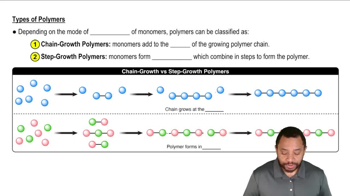
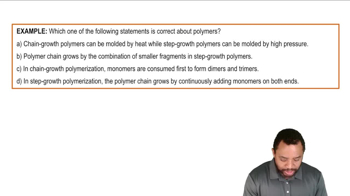
Types of Polymers

Polymers can be classified into various types based on their chemical structure and the nature of their monomers. Common types include polyamides, which are formed from amino acids, and polyesters, which are derived from diols and dicarboxylic acids. Understanding the type of polymer is crucial for predicting its properties and applications.
Video consigliato:
Percorso guidato
2:09
Introduction to Polymers Concept 2

Hydrolysis of Polymers

Hydrolysis is a chemical process that involves the breakdown of polymers into their monomeric units through the addition of water. This reaction is essential for understanding how polymers can be synthesized and degraded, as well as for determining the monomers released during complete hydrolysis, which is a key part of the question.
Video consigliato:
Percorso guidato
1:07
Introduction to Polymers Example 2

Monomer Structures

Monomers are the basic building blocks of polymers, and their structures dictate the properties of the resulting polymer. Identifying the monomers used to create a polymer involves analyzing the repeating units and functional groups present in the polymer structure. This knowledge is vital for suggesting potential monomers or derivatives for polymer synthesis.
Video consigliato:
03:04
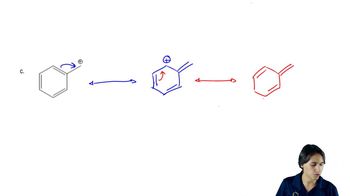
Drawing Resonance Structures
Pratica correlata
Domanda del libro di testo

In each part, rank the compounds in order of increasing rate of nucleophilic attack at C=O by a strong nucleophile like methoxide.

(b)

355
views

Domanda del libro di testo

The structures of four useful polymers are shown, together with some of their best-known products. In each case,

(i) determine the kind of polymer (polyamide, polyester, etc.).

(c)

(d)

706
views
Domanda del libro di testo

In Section 21-16, we saw that Sevin insecticide is made by the reaction of 1-naphthol with methyl isocyanate. A Union Carbide plant in Bhopal, India, once used this process to make Sevin for use as an agricultural insecticide. On December 3,1984, either by accident or by sabotage, a valve was opened that admitted water to a large tank of methyl isocyanate. The pressure and temperature within the tank rose dramatically, and pressure-relief valves opened to keep the tank from bursting. A large quantity of methyl isocyanate rushed out through the pressure-relief valves, and the vapors flowed with the breeze into populated areas, killing about 2500 people and injuring many more.

(a) Write an equation for the reaction that took place in the tank. Explain why the pressure and temperature rose dramatically.

(b) Propose a mechanism for the reaction you wrote in part (a).

989
views
Domanda del libro di testo

An unknown compound gives a mass spectrum with a weak molecular ion at m/z 113 and a prominent ion at m/z 68. Its NMR and IR spectra are shown here. Determine the structure, and show how it is consistent with the observed absorptions. Propose a favorable fragmentation to explain the prominent MS peak at m/z 68.

<IMAGE>

2059
views
Domanda del libro di testo

The structures of four useful polymers are shown, together with some of their best-known products. In each case,

(i) Determine the kind of polymer (polyamide, polyester, etc.).

(ii) Draw the structures of the monomers that would be released by complete hydrolysis.

(iii) Suggest what monomers or stable derivatives of the monomers might be used to make these polymers.

(b)

716
views
Domanda del libro di testo

Explain this curious result. What does this reaction tell you about the relative reactivity of esters and ketones?

580
views