Ch. 21 - Carboxylic Acid Derivatives
Wade - Organic Chemistry 9th Edition
Wade9th EditionOrganic ChemistryISBN: 9780135213728Non è quello che usi tu?Cambia libro di testo
Capitolo 21, Problema 1q,r

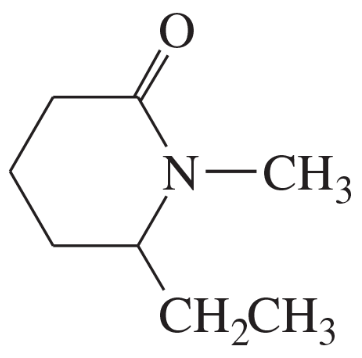
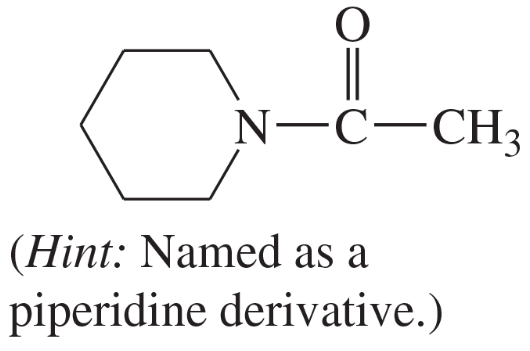
Name the following carboxylic acid derivatives, giving both a common name and an IUPAC name where possible.
(q)
(r)

Guida verificata passo dopo passo
1
Step 1: Identify the functional group in the structure. Both images show carboxylic acid derivatives, specifically amides. The carbonyl group (C=O) is directly bonded to a nitrogen atom (N), which is characteristic of amides.
Step 2: Analyze the substituents attached to the nitrogen atom. In the first structure (q), the nitrogen is bonded to a methyl group (-CH3) and an ethyl group (-CH2CH3). In the second structure (r), the nitrogen is bonded to a methyl group (-CH3).
Step 3: Determine the parent structure. Both structures are derivatives of piperidine, a six-membered ring containing one nitrogen atom. The carbonyl group is attached to the nitrogen atom of the piperidine ring.
Step 4: Assign the common name. For the first structure (q), the common name is N-methyl-N-ethylpiperidinecarboxamide, reflecting the substituents on the nitrogen and the piperidine ring. For the second structure (r), the common name is N-methylpiperidinecarboxamide.
Step 5: Assign the IUPAC name. For the first structure (q), the IUPAC name is N-methyl-N-ethyl-1-piperidinecarboxamide. For the second structure (r), the IUPAC name is N-methyl-1-piperidinecarboxamide. The numbering starts at the nitrogen atom in the piperidine ring, and the carboxamide group is indicated as a substituent.

Risposta video verificata per un problema simile:

Questa soluzione video è stata consigliata dai nostri tutor come utile per risolvere questo problema.
Durata del video:
7m

Concetti chiave

Ecco i concetti essenziali che devi comprendere per rispondere correttamente alla domanda.

Carboxylic Acid Derivatives

Carboxylic acid derivatives include compounds such as esters, amides, and anhydrides, which are derived from carboxylic acids. They retain the carbonyl (C=O) group but differ in the substituents attached to the carbonyl carbon. Understanding these derivatives is crucial for naming and identifying their structures, as they exhibit distinct chemical properties and reactivities.
Video consigliato:
03:50
Intro to Carboxylic Acid Derivatives

IUPAC Nomenclature

The International Union of Pure and Applied Chemistry (IUPAC) nomenclature provides a systematic method for naming organic compounds. It involves identifying the longest carbon chain, functional groups, and substituents to create a unique name. Familiarity with IUPAC rules is essential for accurately naming carboxylic acid derivatives and understanding their structural features.
Video consigliato:
03:43
The different parts of an IUPAC name

Functional Groups

Functional groups are specific groups of atoms within molecules that determine the chemical properties and reactions of those molecules. In the context of carboxylic acid derivatives, the presence of functional groups like amides (RCONR') or esters (RCOOR') influences their reactivity and interactions. Recognizing these groups is vital for predicting the behavior of the compounds in chemical reactions.
Video consigliato:
02:36
Identifying Functional Groups