Ch. 21 - Carboxylic Acid Derivatives
Wade - Organic Chemistry 9th Edition
Wade9th EditionOrganic ChemistryISBN: 9780135213728Non è quello che usi tu?Cambia libro di testo
Capitolo 21, Problema 1f

Name the following carboxylic acid derivatives, giving both a common name and an IUPAC name where possible.
(f) CH3CH(OH)CH2CN

Guida verificata passo dopo passo
1
Step 1: Analyze the problem and identify the functional groups in each compound. Carboxylic acid derivatives include esters, amides, and anhydrides. For each compound, locate the functional group and any substituents attached to the main chain or aromatic ring.
Step 2: For compound (a) PhCOOCH2CH(CH3)2, identify the ester functional group. The aromatic ring (Ph) is attached to the carbonyl group, and the alkyl group is isopropylmethyl. Use the common naming convention (alkyl group + benzoate) and the IUPAC naming convention (alkyl benzenecarboxylate).
Step 3: For compound (b) PhOCHO, identify the aldehyde functional group attached to the aromatic ring. The common name is benzaldehyde, and the IUPAC name is benzenecarbaldehyde.
Step 4: For compound (c) PhCH(CH3)COOCH3, identify the ester functional group. The aromatic ring (Ph) is attached to a chain with a methyl substituent and a methoxy group. Use the common naming convention (alkyl group + phenylacetate) and the IUPAC naming convention (methyl 2-phenylpropanoate).
Step 5: For compound (d) PhNHCOCH2CH(CH3)2, identify the amide functional group. The aromatic ring (Ph) is attached to the nitrogen atom, and the alkyl group is isopropylmethyl. Use the common naming convention (alkyl group + benzamide) and the IUPAC naming convention (N-phenyl-2-methylpropanamide).

Risposta video verificata per un problema simile:

Questa soluzione video è stata consigliata dai nostri tutor come utile per risolvere questo problema.
Durata del video:
3m

Concetti chiave

Ecco i concetti essenziali che devi comprendere per rispondere correttamente alla domanda.

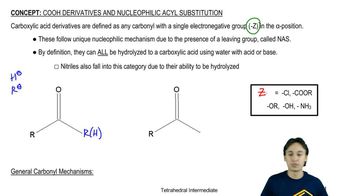
Carboxylic Acid Derivatives

Carboxylic acid derivatives include compounds such as esters, amides, and anhydrides, which are derived from carboxylic acids. They retain the carboxyl functional group (–COOH) but have different substituents replacing the hydroxyl group (–OH). Understanding the structure and reactivity of these derivatives is crucial for naming and synthesizing organic compounds.
Video consigliato:
03:50
Intro to Carboxylic Acid Derivatives

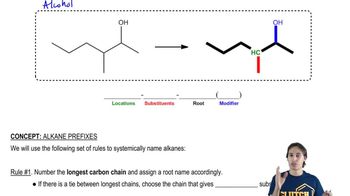
IUPAC Nomenclature

The International Union of Pure and Applied Chemistry (IUPAC) nomenclature provides a systematic method for naming organic compounds. It involves identifying the longest carbon chain, determining the functional groups, and applying specific rules for naming based on the structure. Familiarity with IUPAC rules is essential for accurately naming carboxylic acid derivatives and other organic molecules.
Video consigliato:
03:43
The different parts of an IUPAC name

Common Names vs. IUPAC Names

Common names are often simpler and more widely recognized names for compounds, while IUPAC names follow a standardized set of rules. For example, acetic acid is the common name for ethanoic acid. Understanding both naming conventions is important for effective communication in organic chemistry, as different contexts may require different naming styles.
Video consigliato:
03:43
The different parts of an IUPAC name