
Ch. 21 - Carboxylic Acid Derivatives
Wade - Organic Chemistry 9th Edition
Wade9th EditionOrganic ChemistryISBN: 9780135213728Non è quello che usi tu?Cambia libro di testo
Capitolo 21, Problema 50k

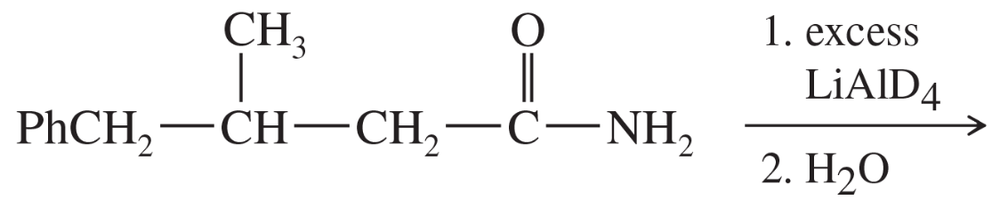
Predict the products of the following reactions.
(k)

Guida verificata passo dopo passo
1
Step 1: Identify the functional groups in the given compound. The molecule contains a benzyl group (PhCH2), a secondary alcohol (CH3-CH), and an amide group (C=O-NH2).
Step 2: Recognize the reagent used in the reaction. Lithium aluminum hydride (LiAlH4) is a strong reducing agent that can reduce amides to amines and other carbonyl compounds to alcohols.
Step 3: Predict the reduction of the amide group. The amide group (C=O-NH2) will be reduced to a primary amine (-CH2-NH2) by LiAlH4.
Step 4: Consider the reduction of other carbonyl groups. If there were any aldehydes or ketones present, they would also be reduced to alcohols. However, in this molecule, the amide is the primary target for reduction.
Step 5: Write the final structure after reduction. The benzyl group (PhCH2) and the secondary alcohol (CH3-CH) remain unchanged, while the amide group is converted to a primary amine (-CH2-NH2).

Risposta video verificata per un problema simile:

Questa soluzione video è stata consigliata dai nostri tutor come utile per risolvere questo problema.
Durata del video:
55s

Concetti chiave

Ecco i concetti essenziali che devi comprendere per rispondere correttamente alla domanda.

Reduction Reactions

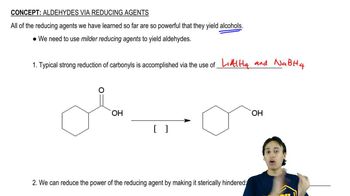
Reduction reactions involve the gain of electrons or the decrease in oxidation state by a molecule. In organic chemistry, this often refers to the conversion of carbonyl compounds (like ketones and aldehydes) to alcohols. Lithium aluminum hydride (LiAlH4) is a strong reducing agent commonly used to reduce carbonyl groups to alcohols.
Video consigliato:
07:12
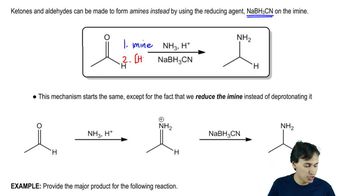
Reductive Amination

Lithium Aluminum Hydride (LiAlH4)

LiAlH4 is a powerful reducing agent used in organic synthesis. It can reduce a variety of functional groups, including esters, carboxylic acids, and amides, to their corresponding alcohols. In the given reaction, excess LiAlH4 will reduce the amide group to an amine and the carbonyl group to an alcohol, showcasing its versatility in functional group transformations.
Video consigliato:
02:07
Why LiAlH4 doesn't work

Hydrolysis of Alkoxides

After reduction with LiAlH4, the resulting alkoxide must be hydrolyzed to yield the final alcohol and amine products. This is typically done by adding water (H2O) to the reaction mixture, which reacts with the alkoxide to form the corresponding alcohol and release the aluminum salts. This step is crucial for completing the transformation and obtaining the desired products.
Video consigliato:
Percorso guidato
3:09
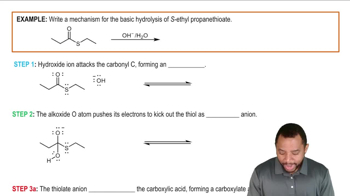
Hydrolysis of Thioesters Example 2