Ch. 21 - Carboxylic Acid Derivatives
Wade - Organic Chemistry 9th Edition
Wade9th EditionOrganic ChemistryISBN: 9780135213728Non è quello che usi tu?Cambia libro di testo
Capitolo 21, Problema 49e

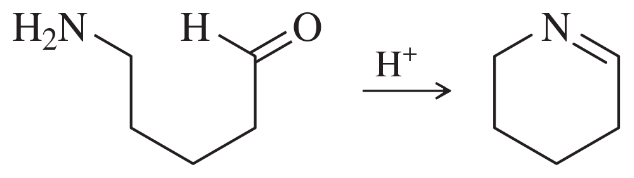
Propose mechanisms for the following reactions.
(e)

Guida verificata passo dopo passo
1
Step 1: Recognize the reaction type. This is an intramolecular cyclization reaction involving the formation of a cyclic imine (a six-membered ring) from an amino ketone under acidic conditions.
Step 2: Protonation of the carbonyl group. Under acidic conditions, the oxygen atom of the ketone group is protonated, increasing the electrophilicity of the carbonyl carbon and making it more susceptible to nucleophilic attack.
Step 3: Nucleophilic attack by the amine group. The lone pair of electrons on the nitrogen atom of the amine group attacks the electrophilic carbonyl carbon, forming a tetrahedral intermediate.
Step 4: Elimination of water. The intermediate undergoes dehydration (loss of a water molecule), leading to the formation of a double bond between the carbon and nitrogen atoms.
Step 5: Formation of the cyclic imine. The reaction completes with the formation of a six-membered ring structure containing a double bond between the carbon and nitrogen atoms, stabilized under acidic conditions.

Risposta video verificata per un problema simile:

Questa soluzione video è stata consigliata dai nostri tutor come utile per risolvere questo problema.
Durata del video:
3m

Concetti chiave

Ecco i concetti essenziali che devi comprendere per rispondere correttamente alla domanda.

Aldehyde Reactivity

Aldehydes are highly reactive carbonyl compounds characterized by the presence of a carbonyl group (C=O) bonded to at least one hydrogen atom. This reactivity allows them to undergo nucleophilic addition reactions, where nucleophiles, such as amines, can attack the electrophilic carbon of the carbonyl, leading to the formation of various products, including imines.
Video consigliato:
01:34
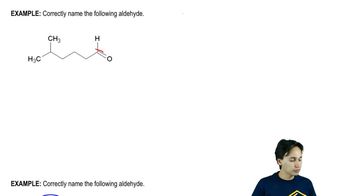
Name the aldehyde

Imine Formation

Imine formation occurs when a primary amine reacts with an aldehyde or ketone, resulting in the condensation of the amine and carbonyl compound. This reaction typically involves the nucleophilic attack of the amine on the carbonyl carbon, followed by the elimination of water. The resulting imine features a carbon-nitrogen double bond (C=N), which is a key functional group in organic chemistry.
Video consigliato:
06:23
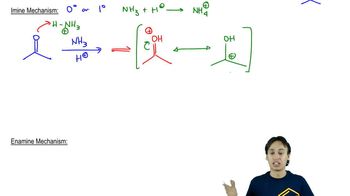
Imine Mechanism

Protonation and Equilibrium

Protonation refers to the addition of a proton (H+) to a molecule, which can enhance the electrophilicity of the carbonyl carbon in aldehydes. In the context of imine formation, protonation of the carbonyl oxygen increases the positive charge on the carbon, making it more susceptible to nucleophilic attack by the amine. Understanding the role of protonation is crucial for predicting the direction of the reaction and the stability of intermediates.
Video consigliato:
04:00
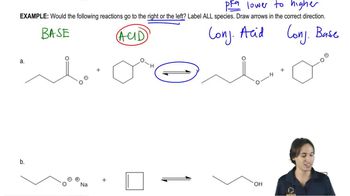
Determining Acid/Base Equilibrium