Ch. 21 - Carboxylic Acid Derivatives
Wade - Organic Chemistry 9th Edition
Wade9th EditionOrganic ChemistryISBN: 9780135213728Non è quello che usi tu?Cambia libro di testo
Capitolo 21, Problema 39b

Show how each transformation may be accomplished by using a nitrile as an intermediate. You may use any necessary reagents.
(b) cyclohexanecarboxamide → cyclohexyl ethyl ketone

Guida verificata passo dopo passo
1
Identify the starting material and the target product. The starting material is cyclohexanecarboxamide, and the target product is cyclohexyl ethyl ketone. The goal is to use a nitrile as an intermediate in the transformation.
Convert the starting material (cyclohexanecarboxamide) into a nitrile. This can be achieved by dehydrating the amide using a dehydrating agent such as phosphorus pentoxide (P2O5) or thionyl chloride (SOCl2). This step will yield cyclohexanecarbonitrile.
Perform a Grignard reaction to introduce the ethyl group. React cyclohexanecarbonitrile with ethylmagnesium bromide (C2H5MgBr) in an ether solvent. This step will form an imine intermediate.
Hydrolyze the imine intermediate to yield the ketone. Use aqueous acid (e.g., H3O+) to hydrolyze the imine, resulting in cyclohexyl ethyl ketone.
Verify the structure of the product to ensure it matches the target compound, cyclohexyl ethyl ketone. This completes the transformation using a nitrile as an intermediate.

Risposta video verificata per un problema simile:

Questa soluzione video è stata consigliata dai nostri tutor come utile per risolvere questo problema.
Durata del video:
2m

Concetti chiave

Ecco i concetti essenziali che devi comprendere per rispondere correttamente alla domanda.

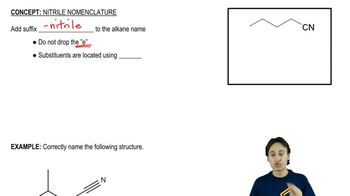
Nitrile Chemistry

Nitriles are organic compounds containing a cyano group (-C≡N). They can be converted into various functional groups through hydrolysis, reduction, or other transformations. Understanding the reactivity of nitriles is crucial for using them as intermediates in organic synthesis, as they can be transformed into amides, carboxylic acids, or ketones depending on the reagents and conditions applied.
Video consigliato:
01:01
Nitrile Nomenclature

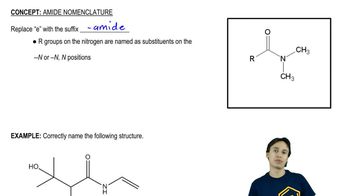
Amide to Ketone Transformation

The conversion of an amide to a ketone can be achieved through a series of reactions, often involving the formation of a nitrile intermediate. This process typically includes the dehydration of the amide to form a nitrile, followed by hydrolysis or other reactions to yield the desired ketone. Recognizing the steps involved in this transformation is essential for successfully synthesizing cyclohexyl ethyl ketone from cyclohexanecarboxamide.
Video consigliato:
01:33
Amide Nomenclature

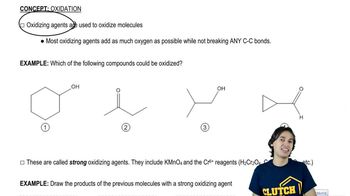
Reagents and Reaction Conditions

The choice of reagents and reaction conditions is critical in organic synthesis. For the transformation in question, reagents such as phosphorus oxychloride (POCl3) or thionyl chloride (SOCl2) may be used to convert the amide to a nitrile. Additionally, understanding the role of reducing agents or hydrolytic conditions is necessary to facilitate the final conversion to the ketone, ensuring the correct pathway is followed for the desired product.
Video consigliato:
01:52
Reagents