

Ch. 21 - Carboxylic Acid Derivatives
Wade - Organic Chemistry 9th Edition
Wade9th EditionOrganic ChemistryISBN: 9780135213728Non è quello che usi tu?Cambia libro di testo
Capitolo 21, Problema 38c

Show how you would convert the following starting materials to the indicated nitriles:
(c) p-chloronitrobenzene → p-chlorobenzonitrile

Guida verificata passo dopo passo
1
Identify the functional group transformation: The problem requires converting a nitro group (-NO₂) on p-chloronitrobenzene to a nitrile group (-CN) while retaining the chlorine substituent on the benzene ring.
Recognize the reaction type: This transformation involves a two-step process. First, the nitro group (-NO₂) is reduced to an amine group (-NH₂). Then, the amine group is converted to a nitrile group (-CN) via a Sandmeyer reaction.
Step 1: Reduction of the nitro group to an amine group. Use a reducing agent such as Sn/HCl or Fe/HCl to reduce the nitro group (-NO₂) on p-chloronitrobenzene to an amine group (-NH₂), forming p-chloroaniline.
Step 2: Diazotization of the amine group. Treat p-chloroaniline with sodium nitrite (NaNO₂) and hydrochloric acid (HCl) at 0–5°C to form the diazonium salt intermediate, p-chlorobenzenediazonium chloride.
Step 3: Sandmeyer reaction to introduce the nitrile group. React the diazonium salt with copper(I) cyanide (CuCN) to replace the diazonium group (-N₂⁺) with a nitrile group (-CN), yielding p-chlorobenzonitrile as the final product.

Risposta video verificata per un problema simile:

Questa soluzione video è stata consigliata dai nostri tutor come utile per risolvere questo problema.
Durata del video:
3m

Concetti chiave

Ecco i concetti essenziali che devi comprendere per rispondere correttamente alla domanda.

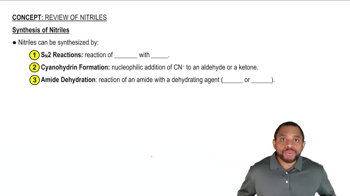
Nitrile Synthesis

Nitriles can be synthesized from various organic compounds through different methods, including the reaction of halides with sodium cyanide or the dehydration of amides. In this case, converting p-chloronitrobenzene to p-chlorobenzonitrile involves a nucleophilic substitution reaction where the nitro group is replaced by a cyano group.
Video consigliato:
Percorso guidato
0:59
Review of Nitriles Concept 1

Nucleophilic Substitution

Nucleophilic substitution is a fundamental reaction in organic chemistry where a nucleophile attacks an electrophilic carbon atom, leading to the replacement of a leaving group. In the conversion of p-chloronitrobenzene to p-chlorobenzonitrile, the nucleophile (cyanide ion) replaces the chlorine atom, demonstrating this key reaction mechanism.
Video consigliato:
01:47
Nucleophiles and Electrophiles can react in Substitution Reactions.

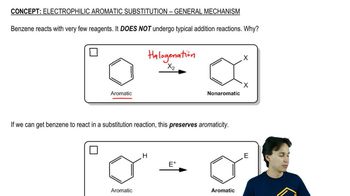
Electrophilic Aromatic Substitution

Electrophilic aromatic substitution (EAS) is a reaction where an electrophile replaces a hydrogen atom on an aromatic ring. In the context of p-chloronitrobenzene, the presence of the nitro group activates the ring towards further substitution, allowing for the introduction of the cyano group in the desired position, which is crucial for achieving the final product.
Video consigliato:
03:07
EAS Review