Ch. 21 - Carboxylic Acid Derivatives
Wade - Organic Chemistry 9th Edition
Wade9th EditionOrganic ChemistryISBN: 9780135213728Non è quello che usi tu?Cambia libro di testo
Capitolo 21, Problema 48c,d

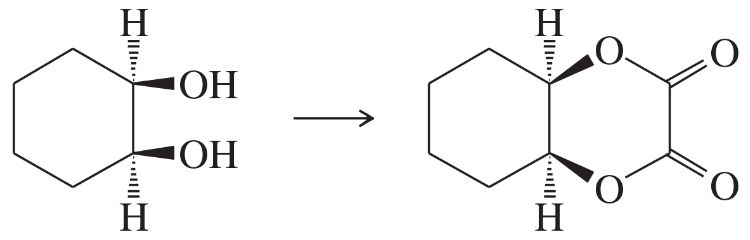
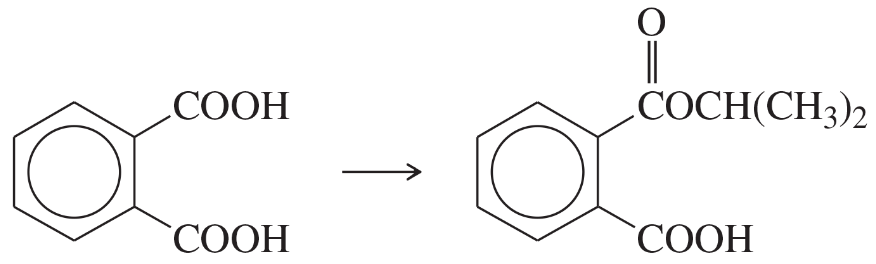
Show how you would accomplish the following syntheses in good yields.
(c)
(d)

Guida verificata passo dopo passo
1
Step 1 (c): Analyze the starting material, which is a cyclohexane derivative with two hydroxyl groups in a cis configuration. The target molecule is a cyclic anhydride formed by the oxidation of these hydroxyl groups.
Step 2 (c): Use a mild oxidizing agent such as PCC (Pyridinium Chlorochromate) or Jones reagent to oxidize the hydroxyl groups to carboxylic acids. Ensure the reaction conditions are controlled to avoid overoxidation.
Step 3 (c): Heat the resulting dicarboxylic acid under dehydrating conditions to promote the formation of the cyclic anhydride. This step typically involves heating the compound in the presence of acetic anhydride or under vacuum.
Step 4 (d): Examine the starting material, which is benzene-1,2,4-tricarboxylic acid. The target molecule involves the introduction of an acetyl group (-COCH(CH3)2) at the 1-position of the benzene ring.
Step 5 (d): Perform a Friedel-Crafts acylation reaction using isobutyryl chloride (CH3)2CHCOCl as the acylating agent and a Lewis acid catalyst such as AlCl3. This reaction selectively introduces the acetyl group at the desired position on the aromatic ring.

Risposta video verificata per un problema simile:

Questa soluzione video è stata consigliata dai nostri tutor come utile per risolvere questo problema.
Durata del video:
11m

Concetti chiave

Ecco i concetti essenziali che devi comprendere per rispondere correttamente alla domanda.

Fischer Esterification

Fischer esterification is a chemical reaction that forms an ester from a carboxylic acid and an alcohol, typically in the presence of an acid catalyst. This reaction is reversible, and the equilibrium can be shifted towards ester formation by removing water or using excess reactants. Understanding this process is crucial for synthesizing esters efficiently, as seen in the provided reaction schemes.
Video consigliato:
Percorso guidato
1:21
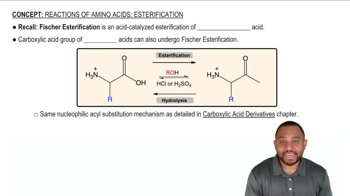
Reactions of Amino Acids: Esterification Concept 1

Cyclic Compounds

Cyclic compounds are organic molecules that contain a ring structure. Their unique geometry can influence reactivity and stability, making them important in organic synthesis. In the context of Fischer esterification, the presence of a cyclic compound can affect the reaction pathway and the yield of the desired ester product, as shown in the first reaction scheme.
Video consigliato:
01:40
Defining meso compounds.

Phenolic Compounds

Phenolic compounds are characterized by the presence of a hydroxyl group (-OH) attached to an aromatic hydrocarbon ring. They can participate in esterification reactions, but their reactivity may differ from aliphatic alcohols due to resonance stabilization. Understanding the behavior of phenolic compounds in Fischer esterification is essential for predicting the outcomes of the reactions depicted in the second scheme.
Video consigliato:
02:27
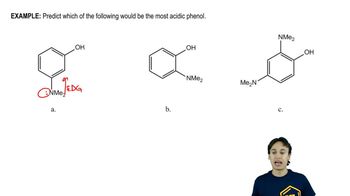
Identify the most acidic phenol