Ch. 21 - Carboxylic Acid Derivatives
Wade - Organic Chemistry 9th Edition
Wade9th EditionOrganic ChemistryISBN: 9780135213728Non è quello che usi tu?Cambia libro di testo
Capitolo 21, Problema 37

Show how you would accomplish the following syntheses using amides as intermediates. You may use any necessary reagents.
(a) benzoic acid → benzyldimethylamine
(b) pyrrolidine → N-ethylpyrrolidine
(c) cyclopentanecarboxylic acid → cyclopentanecarbonitrile

Guida verificata passo dopo passo
1
Step 1: For part (a), begin by converting benzoic acid to benzoyl chloride. This can be achieved using a reagent like thionyl chloride (SOCl₂) or phosphorus pentachloride (PCl₅). The reaction replaces the hydroxyl group (-OH) of the carboxylic acid with a chlorine atom, forming benzoyl chloride.
Step 2: React benzoyl chloride with dimethylamine (H₂NCH₃₂) to form the corresponding amide, N,N-dimethylbenzamide. This reaction typically occurs via nucleophilic acyl substitution, where the amine attacks the carbonyl carbon of the acyl chloride.
Step 3: Reduce the amide (N,N-dimethylbenzamide) to benzyldimethylamine using a reducing agent such as lithium aluminum hydride (LiAlH₄). The reduction converts the amide functional group into an amine, completing the synthesis for part (a).
Step 4: For part (b), start by reacting pyrrolidine with ethyl chloroformate (ClCOOCH₂CH₃) to form an N-ethylcarbamate intermediate. This step introduces the ethyl group onto the nitrogen atom of pyrrolidine.
Step 5: Hydrolyze the carbamate intermediate under acidic or basic conditions to yield N-ethylpyrrolidine. This step removes the carbamate group, leaving the desired ethyl-substituted pyrrolidine.

Risposta video verificata per un problema simile:

Questa soluzione video è stata consigliata dai nostri tutor come utile per risolvere questo problema.
Durata del video:
3m

Concetti chiave

Ecco i concetti essenziali che devi comprendere per rispondere correttamente alla domanda.

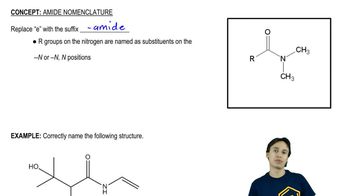
Amides as Intermediates

Amides are organic compounds derived from carboxylic acids and amines, characterized by the functional group -C(=O)N-. They serve as versatile intermediates in organic synthesis, allowing for the transformation of carboxylic acids into amines or other nitrogen-containing compounds through various reactions, such as reduction or alkylation.
Video consigliato:
01:33
Amide Nomenclature

Nucleophilic Substitution Reactions

Nucleophilic substitution reactions involve the replacement of a leaving group in a molecule with a nucleophile. In the context of amides, this can include the alkylation of amides to form substituted amines. Understanding the mechanisms of these reactions is crucial for predicting the products of the syntheses outlined in the question.
Video consigliato:
01:47
Nucleophiles and Electrophiles can react in Substitution Reactions.

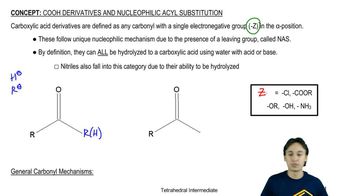
Carboxylic Acid Derivatives

Carboxylic acid derivatives, such as esters, amides, and anhydrides, are compounds that can be derived from carboxylic acids by replacing the hydroxyl group (-OH) with another functional group. Recognizing how these derivatives can be interconverted is essential for the synthesis of target compounds, as they often dictate the reactivity and pathways available in organic reactions.
Video consigliato:
03:50
Intro to Carboxylic Acid Derivatives