Ch. 21 - Carboxylic Acid Derivatives
Wade - Organic Chemistry 9th Edition
Wade9th EditionOrganic ChemistryISBN: 9780135213728Non è quello che usi tu?Cambia libro di testo
Capitolo 21, Problema 16b

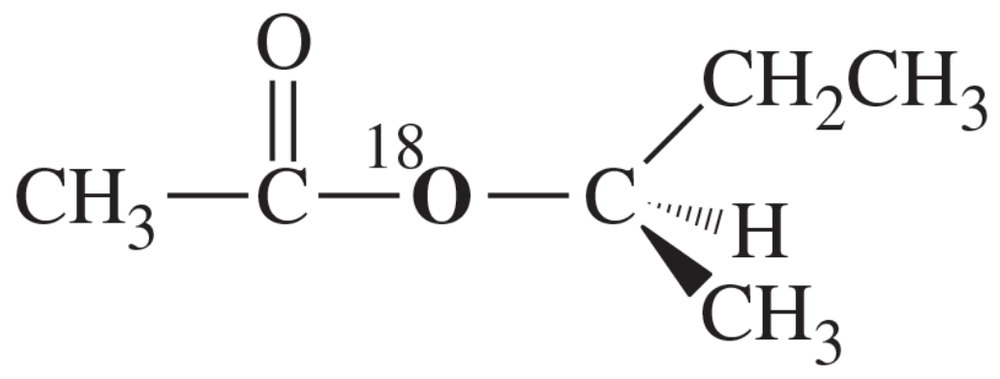
Suppose we have some optically pure (R)-2-butyl acetate that has been "labeled" with the heavy 18O isotope at one oxygen atom as shown.

(b) Repeat part (a) for the acid-catalyzed hydrolysis of this compound.

Guida verificata passo dopo passo
1
Step 1: Recognize that the reaction involves acid-catalyzed hydrolysis of an ester. The ester bond will be cleaved, resulting in the formation of an alcohol and a carboxylic acid.
Step 2: Understand the mechanism of acid-catalyzed hydrolysis. The reaction begins with protonation of the carbonyl oxygen by the acid catalyst (H+), increasing the electrophilicity of the carbonyl carbon.
Step 3: Water acts as a nucleophile and attacks the carbonyl carbon, forming a tetrahedral intermediate. This intermediate contains both the original ester oxygen and the oxygen from water.
Step 4: The tetrahedral intermediate undergoes proton transfer and elimination of the leaving group (the alcohol), resulting in the formation of the carboxylic acid. The heavy isotope O-18 will remain attached to the alcohol group, not the carboxylic acid.
Step 5: Analyze the stereochemistry of the alcohol product. The (R)-configuration of the original compound will be retained in the alcohol product, as the hydrolysis does not affect the stereocenter.

Risposta video verificata per un problema simile:

Questa soluzione video è stata consigliata dai nostri tutor come utile per risolvere questo problema.
Durata del video:
6m

Concetti chiave

Ecco i concetti essenziali che devi comprendere per rispondere correttamente alla domanda.

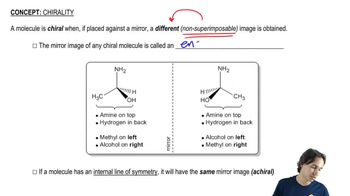
Optical Purity and Chirality

Optical purity refers to the proportion of one enantiomer over another in a chiral compound, which can rotate plane-polarized light. Chirality is a property of a molecule that makes it non-superimposable on its mirror image, often due to the presence of a chiral center, typically a carbon atom bonded to four different substituents. Understanding these concepts is crucial for analyzing reactions involving chiral molecules, such as (R)-2-butyl acetate.
Video consigliato:
05:10
What is chirality?

Acid-Catalyzed Hydrolysis

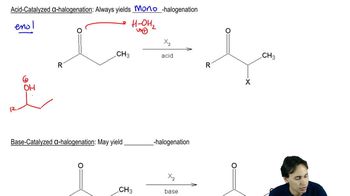
Acid-catalyzed hydrolysis is a reaction where an ester is converted into an alcohol and a carboxylic acid in the presence of an acid catalyst, typically a strong acid like HCl or H2SO4. The acid protonates the carbonyl oxygen, increasing the electrophilicity of the carbonyl carbon, facilitating nucleophilic attack by water. This process is essential for understanding how the labeled (R)-2-butyl acetate reacts in the presence of water and acid.
Video consigliato:
03:09
Acid Catalyzed

Isotope Labeling

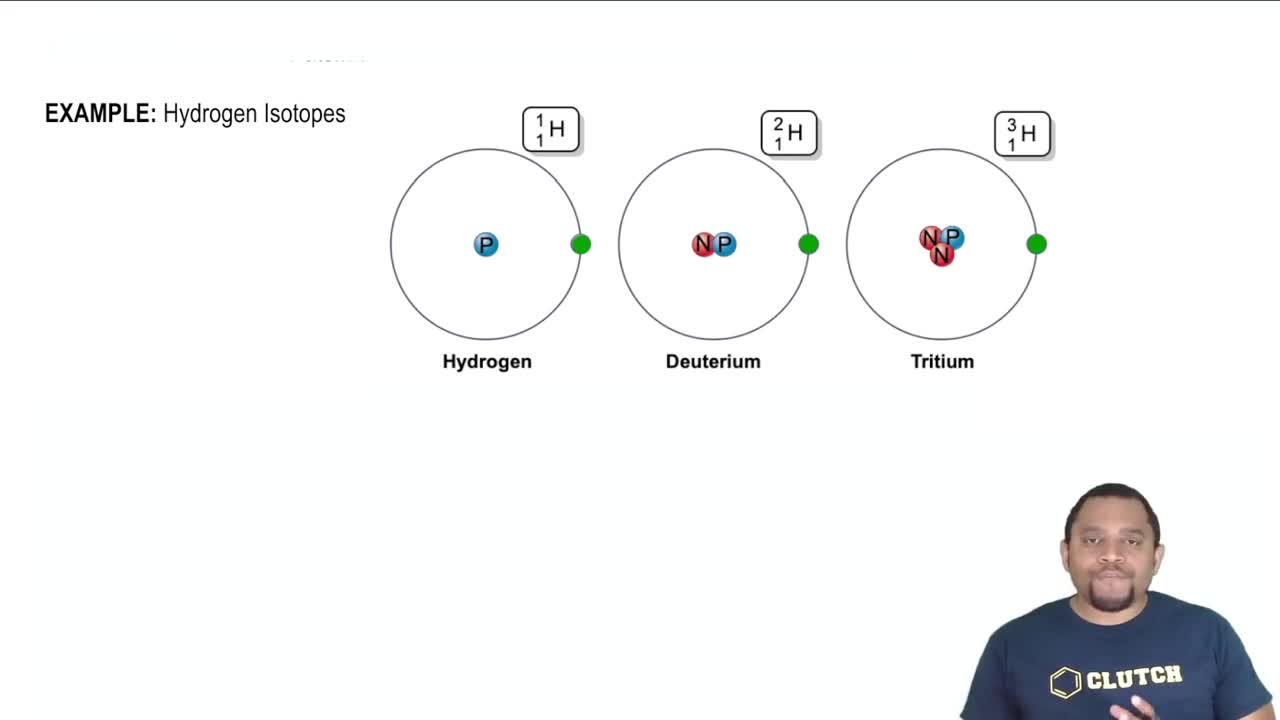
Isotope labeling involves substituting a specific atom in a molecule with a heavier isotope, such as O-18 instead of the more common O-16. This technique is used to trace the movement of atoms through a reaction mechanism, providing insights into reaction pathways and mechanisms. In the context of the hydrolysis of (R)-2-butyl acetate, the presence of O-18 allows for tracking the fate of the oxygen atom during the reaction.
Video consigliato:
03:06
Understanding the hydrogen isotopes.