Ch. 22 - Condensations and Alpha Substitutions of Carbonyl Compounds
Wade - Organic Chemistry 9th Edition
Wade9th EditionOrganic ChemistryISBN: 9780135213728Non è quello che usi tu?Cambia libro di testo
Capitolo 22, Problema 1c2

Phenylacetone can form two different enols.
(c) Propose mechanisms for the formation of the second enol in acid.

Guida verificata passo dopo passo
1
Identify the structure of phenylacetone: It consists of a phenyl group (C₆H₅-) attached to a CH₂ group, which is connected to a carbonyl group (C=O). The carbonyl group is the reactive site for enol formation.
Understand the concept of keto-enol tautomerism: In acidic conditions, the carbonyl compound (phenylacetone) can undergo protonation and rearrangement to form an enol, which is a compound with a hydroxyl group (-OH) attached to a carbon-carbon double bond.
Protonate the carbonyl oxygen: In the presence of an acid, the lone pair of electrons on the oxygen atom of the carbonyl group will accept a proton (H⁺), forming a positively charged oxonium ion (R-C(OH⁺)-R').
Facilitate alpha-hydrogen removal: The acidic environment allows for the removal of an alpha-hydrogen (a hydrogen atom attached to the carbon adjacent to the carbonyl group). This occurs via a resonance-stabilized carbocation intermediate, where the electrons from the C-H bond move to form a double bond between the alpha-carbon and the carbonyl carbon.
Deprotonate the hydroxyl group: A base (such as water) in the solution will remove a proton from the hydroxyl group, resulting in the formation of the enol. The second enol is formed when the alpha-hydrogen on the opposite side of the carbonyl group is removed, leading to a different enol structure.

Risposta video verificata per un problema simile:

Questa soluzione video è stata consigliata dai nostri tutor come utile per risolvere questo problema.
Durata del video:
1m

Concetti chiave

Ecco i concetti essenziali che devi comprendere per rispondere correttamente alla domanda.

Enol Formation

Enols are compounds with a hydroxyl group (-OH) bonded to a carbon atom that is part of a carbon-carbon double bond. The formation of enols typically involves the tautomerization of carbonyl compounds, where the keto form (C=O) converts to the enol form (C=C-OH). Understanding this process is crucial for analyzing how phenylacetone can yield different enols.
Video consigliato:
02:26
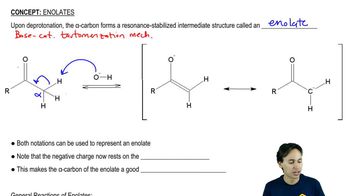
Formation of Enolates

Acid-Catalyzed Mechanism

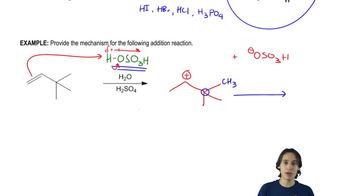
In acid-catalyzed reactions, the presence of an acid facilitates the protonation of the carbonyl oxygen, increasing the electrophilicity of the carbonyl carbon. This step is essential for the subsequent nucleophilic attack by water or alcohol, leading to the formation of enols. Recognizing this mechanism is vital for proposing the correct pathway for enol formation in phenylacetone.
Video consigliato:
06:34
Acid-catalyzed hydration mechanism

Tautomerization

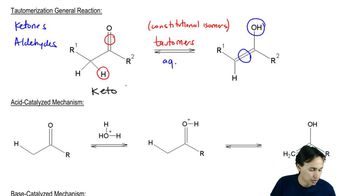
Tautomerization is a chemical reaction that involves the interconversion between two isomers, typically a keto form and an enol form. This process is often facilitated by acid or base catalysts and is characterized by the migration of a hydrogen atom and a shift in the double bond. Understanding tautomerization is key to explaining how phenylacetone can form two distinct enols under acidic conditions.
Video consigliato:
05:11
Tautomerization Mechanisms