Ch. 22 - Condensations and Alpha Substitutions of Carbonyl Compounds
Wade - Organic Chemistry 9th Edition
Wade9th EditionOrganic ChemistryISBN: 9780135213728Non è quello che usi tu?Cambia libro di testo
Capitolo 22, Problema 76

Predict the products from this sequence of reactions.

Guida verificata passo dopo passo
1
Step 1: Analyze the first reaction. The starting compound is a β-keto aldehyde. When treated with NaOH and heat (Δ), an aldol condensation occurs. This reaction involves the deprotonation of the α-hydrogen of the aldehyde group, followed by nucleophilic attack on the ketone group. The product is typically an α,β-unsaturated ketone.
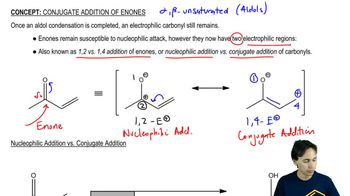
Step 2: Examine the second reaction. The product from the aldol condensation (compound A) reacts with (CH₃)₂CuLi, a Gilman reagent. Gilman reagents are known for their ability to perform conjugate addition (1,4-addition) to α,β-unsaturated carbonyl compounds. The methyl group from the Gilman reagent adds to the β-carbon of the α,β-unsaturated ketone, forming compound B.
Step 3: Consider the third reaction. Compound B reacts with CH₃CH₂Br, an alkyl halide, under conditions likely involving nucleophilic substitution. The enolate form of compound B (generated by deprotonation of the α-hydrogen) acts as a nucleophile and attacks the ethyl bromide, resulting in the formation of compound C.
Step 4: Summarize the transformations. The sequence of reactions involves aldol condensation, conjugate addition, and alkylation. Each step modifies the structure of the original molecule, leading to the final product.
Step 5: Verify the stereochemistry and regiochemistry. Ensure that the conjugate addition and alkylation occur at the correct positions, and confirm that the final product (compound C) is consistent with the expected reaction mechanisms.

Risposta video verificata per un problema simile:

Questa soluzione video è stata consigliata dai nostri tutor come utile per risolvere questo problema.
Durata del video:
12m

Concetti chiave

Ecco i concetti essenziali che devi comprendere per rispondere correttamente alla domanda.

Michael Addition

Michael addition is a nucleophilic addition reaction where a nucleophile adds to an α,β-unsaturated carbonyl compound. In this reaction, the nucleophile attacks the β-carbon, leading to the formation of a new carbon-carbon bond. Understanding this mechanism is crucial for predicting the products of the reaction sequence shown in the question.
Video consigliato:
09:23
1,2 vs 1,4 Addition

Reagents and Conditions

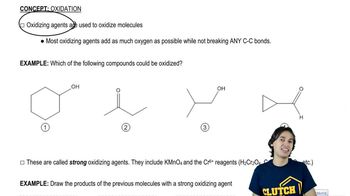
The choice of reagents and conditions significantly influences the outcome of organic reactions. In this sequence, sodium hydroxide (NaOH) and heat are used to facilitate the Michael addition, while (CH3)2CuLi acts as a nucleophile in the subsequent step. Recognizing how these reagents interact with the substrates is essential for predicting the products A, B, and C.
Video consigliato:
01:52
Reagents

Stereochemistry and Product Formation

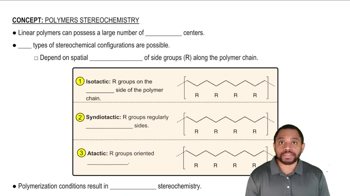
Stereochemistry plays a vital role in determining the structure of the products formed in organic reactions. The orientation of substituents around the newly formed bonds can lead to different stereoisomers. In this reaction sequence, understanding the stereochemical implications of each step is important for accurately predicting the final products.
Video consigliato:
Percorso guidato
1:38
Polymer Stereochemistry Concept 1