Ch. 22 - Condensations and Alpha Substitutions of Carbonyl Compounds
Wade - Organic Chemistry 9th Edition
Wade9th EditionOrganic ChemistryISBN: 9780135213728Non è quello che usi tu?Cambia libro di testo
Capitolo 22, Problema 85b

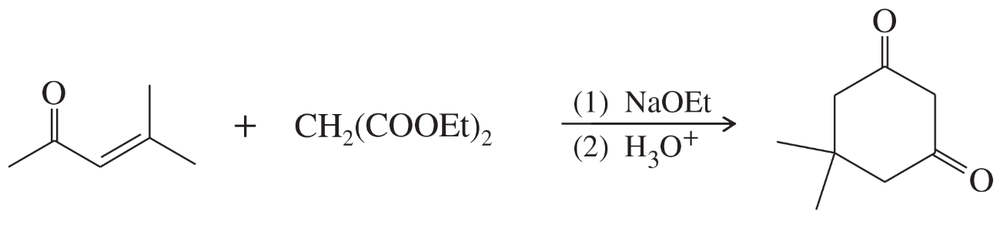
Show reaction sequences (not detailed mechanisms) that explain these transformations:
(b)

Guida verificata passo dopo passo
1
Step 1: Identify the starting materials and reagents. The starting materials are acetone (a ketone) and diethyl malonate (CH₂(COOEt)₂). The reagents are sodium ethoxide (NaOEt) and acid (H₃O⁺). This suggests a reaction sequence involving enolate formation and subsequent condensation.
Step 2: Enolate formation. Sodium ethoxide (NaOEt) acts as a base to deprotonate the alpha-hydrogen of acetone, forming an enolate ion. This enolate is nucleophilic and can attack electrophilic centers.
Step 3: Michael addition. The enolate of acetone reacts with diethyl malonate via a conjugate addition (Michael addition) to the double bond of diethyl malonate. This forms a new carbon-carbon bond and generates an intermediate with both ketone and ester functionalities.
Step 4: Intramolecular cyclization. The intermediate undergoes intramolecular cyclization, where the nucleophilic enolate attacks the ester carbonyl group, forming a six-membered ring structure. This step is facilitated by the acidic or basic conditions.
Step 5: Hydrolysis and decarboxylation. Under acidic conditions (H₃O⁺), the ester groups are hydrolyzed to carboxylic acids, and subsequent decarboxylation occurs, yielding the final cyclic diketone product.

Risposta video verificata per un problema simile:

Questa soluzione video è stata consigliata dai nostri tutor come utile per risolvere questo problema.
Durata del video:
7m

Concetti chiave

Ecco i concetti essenziali che devi comprendere per rispondere correttamente alla domanda.

Reaction Mechanisms

Reaction mechanisms describe the step-by-step process by which reactants are converted into products. Understanding the general types of mechanisms, such as nucleophilic substitution or elimination, is crucial for predicting the outcome of a reaction. While detailed mechanisms are not required in this case, knowing the overall pathway helps in visualizing how transformations occur.
Video consigliato:
02:16
Heck Reaction Mechanism

Functional Groups

Functional groups are specific groups of atoms within molecules that are responsible for the characteristic chemical reactions of those molecules. Identifying the functional groups present in the reactants and products is essential for understanding how transformations occur. This knowledge allows chemists to predict reactivity and selectivity in organic reactions.
Video consigliato:
02:36
Identifying Functional Groups

Reaction Conditions

Reaction conditions refer to the specific parameters under which a chemical reaction takes place, including temperature, pressure, solvent, and catalysts. These conditions can significantly influence the rate and outcome of a reaction. Recognizing the importance of these factors is vital for successfully proposing reaction sequences that lead to the desired transformations.
Video consigliato:
Percorso guidato
1:18
EAS Reactions of Pyridine Example 1