

Ch. 23 - Carbohydrates and Nucleic Acids
Wade - Organic Chemistry 9th Edition
Wade9th EditionOrganic ChemistryISBN: 9780135213728Non è quello che usi tu?Cambia libro di testo
Capitolo 23, Problema 53

Draw the following sugar derivatives.
(a) methyl β-D-glucopyranoside
(b) 2,3,4,6-tetra-O-methyl-D-mannopyranose
(c) 1,3,6-tri-O-methyl-D-fructofuranose
(d) methyl 2,3,4,6-tetra-O-methyl-β-D-galactopyranoside

Guida verificata passo dopo passo
1
Step 1: Understand the structure of the parent sugar for each derivative. For example, glucopyranoside is derived from glucose, mannopyranose from mannose, fructofuranose from fructose, and galactopyranoside from galactose. These sugars are cyclic forms of their respective monosaccharides.
Step 2: Identify the modifications specified in the problem. For example, 'methyl' indicates the addition of a methoxy group (-OCH₃) at specific positions, and 'tetra-O-methyl' or 'tri-O-methyl' indicates multiple hydroxyl groups (-OH) are replaced with methoxy groups.
Step 3: Draw the cyclic structure of the sugar in its correct stereochemical form. For example, for β-D-glucopyranoside, draw the six-membered pyranose ring with the hydroxyl groups and substituents in their correct stereochemical positions (axial or equatorial).
Step 4: Add the specified substituents. For example, for methyl β-D-glucopyranoside, replace the anomeric hydroxyl group (-OH) with a methoxy group (-OCH₃) while maintaining the β-configuration. For tetra-O-methyl derivatives, replace the hydroxyl groups at the specified positions (e.g., 2, 3, 4, and 6) with methoxy groups.
Step 5: Verify the stereochemistry and connectivity of the final structure. Ensure that the substituents are correctly placed and that the stereochemistry matches the D- or L-configuration and the α- or β-anomeric designation as specified in the problem.

Risposta video verificata per un problema simile:

Questa soluzione video è stata consigliata dai nostri tutor come utile per risolvere questo problema.

Concetti chiave

Ecco i concetti essenziali che devi comprendere per rispondere correttamente alla domanda.

Sugar Structure and Anomeric Carbon

Understanding the structure of sugars, particularly their cyclic forms, is essential. Sugars like glucose and galactose can exist in pyranose (six-membered) or furanose (five-membered) rings. The anomeric carbon, which is the carbon derived from the carbonyl group during cyclization, plays a crucial role in determining the sugar's reactivity and properties.
Video consigliato:
04:06
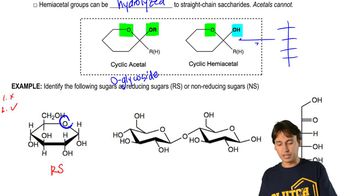
Identify the following sugars

Methylation of Sugars

Methylation involves the addition of methyl groups (-CH3) to hydroxyl (-OH) groups on sugars, which alters their solubility and reactivity. In the context of sugar derivatives, understanding how to represent these modifications is key to drawing the correct structures, as each methylation affects the overall configuration and properties of the sugar.
Video consigliato:
08:42
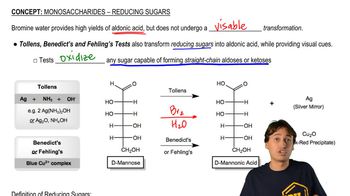
Reducing Sugars

Stereochemistry in Carbohydrates

Stereochemistry is vital in organic chemistry, especially for carbohydrates, as the spatial arrangement of atoms can significantly influence their biological function. Recognizing the D- and L- configurations, as well as the orientation of hydroxyl groups in sugar derivatives, is crucial for accurately depicting and understanding their structures.
Video consigliato:
Percorso guidato
1:38
Polymer Stereochemistry Concept 1
Pratica correlata
Domanda del libro di testo

Which of the following sugars are reducing sugars? Which ones would undergo mutarotation?

(a) methyl β-D-glucopyranoside

(b) 2,3,4,6-tetra-O-methyl-D-mannopyranose

(c) 1,3,6-tri-O-methyl-D-fructofuranose

(d) methyl 2,3,4,6-tetra-O-methyl-β-D-galactopyranoside

1114
views
Domanda del libro di testo

Draw the structures (using chair conformations of pyranoses) of the following disaccharides.

(a) 4-O-(α-D-glucopyranosyl)-D-galactopyranose

(b) α-D-fructofuranosyl-β-D-mannopyranoside

(c) 6-O-(β-D-galactopyranosyl)-D-glucopyranose

1435
views
Domanda del libro di testo

Predict the products obtained when D-galactose reacts with each reagent.

(k) excess HIO4

1099
views
Domanda del libro di testo

Erwin Chargaff’s discovery that DNA contains equimolar amounts of guanine and cytosine and also equimolar amounts of adenine and thymine has come to be known as Chargaff’s rule:

G = C and A = T

(a) Does Chargaff’s rule imply that equal amounts of guanine and adenine are present in DNA? That is, does G = A?

(b) Does Chargaff’s rule imply that the sum of the purine residues equals the sum of the pyrimidine residues? That is, does A + G = C + T?

(c) Does Chargaff’s rule apply only to double-stranded DNA, or would it also apply to each individual strand if the double helical strand were separated into its two complementary strands?

1127
views
Domanda del libro di testo

Predict the products obtained when D-galactose reacts with each reagent.

(i) Br2, H2O, then H2O2 and Fe2(SO4)3

1658
views
Domanda del libro di testo

Predict the products obtained when D-galactose reacts with each reagent.

(j) (1) KCN/HCN; (2) H2, Pd/BaSO4; (3) H3O+

932
views