Ch. 23 - Carbohydrates and Nucleic Acids
Wade - Organic Chemistry 9th Edition
Wade9th EditionOrganic ChemistryISBN: 9780135213728Non è quello che usi tu?Cambia libro di testo
Capitolo 23, Problema 52k

Predict the products obtained when D-galactose reacts with each reagent.
(k) excess HIO4

Guida verificata passo dopo passo
1
Understand the reaction: Periodic acid (HIO4) is an oxidizing agent that cleaves vicinal diols (two hydroxyl groups on adjacent carbons) in carbohydrates. It breaks the C-C bond between the carbons bearing the hydroxyl groups, forming smaller carbonyl-containing fragments such as aldehydes or formic acid.
Analyze the structure of D-galactose: D-galactose is an aldohexose, meaning it has six carbons, with an aldehyde group at C1 and hydroxyl groups on the other carbons. Draw the Fischer projection of D-galactose to visualize the vicinal diols.
Identify the vicinal diols: In D-galactose, vicinal diols are present between C2-C3, C3-C4, C4-C5, and C5-C6. These are the sites where HIO4 will cleave the C-C bonds.
Determine the cleavage products: For each vicinal diol, the C-C bond is broken, and each carbon forms a carbonyl group. Depending on the position of the carbon, the products will be either formaldehyde (HCHO), formic acid (HCOOH), or a larger aldehyde/ketone.
Combine the results: After cleaving all vicinal diols in excess HIO4, the D-galactose molecule will be completely broken down into smaller fragments. Write out the specific products formed from each cleavage site to complete the reaction analysis.

Risposta video verificata per un problema simile:

Questa soluzione video è stata consigliata dai nostri tutor come utile per risolvere questo problema.

Concetti chiave

Ecco i concetti essenziali che devi comprendere per rispondere correttamente alla domanda.

D-Galactose Structure

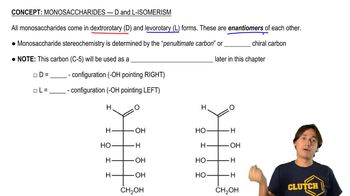
D-galactose is a six-carbon aldose sugar with a specific stereochemistry. It contains an aldehyde group at one end and multiple hydroxyl groups, which influence its reactivity. Understanding its structure is crucial for predicting how it will react with various reagents, including oxidative agents like HIO4.
Video consigliato:
06:47
Monosaccharides - D and L Isomerism

Periodic Acid Oxidation

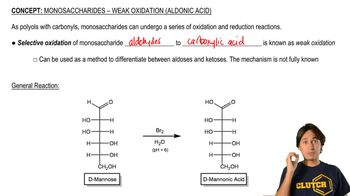
Periodic acid (HIO4) is a strong oxidizing agent that cleaves vicinal diols and aldehydes. In the case of sugars, it can oxidatively cleave the carbon-carbon bonds adjacent to hydroxyl groups, leading to the formation of smaller aldehydes or ketones. This reaction is essential for understanding the products formed when d-galactose is treated with excess HIO4.
Video consigliato:
04:15
Monosaccharides - Weak Oxidation (Aldonic Acid)

Reaction Mechanism

The reaction mechanism describes the step-by-step process by which reactants are converted into products. For d-galactose reacting with HIO4, the mechanism involves the formation of cyclic intermediates and subsequent cleavage of the sugar backbone. A clear grasp of these mechanisms helps in predicting the final products of the reaction.
Video consigliato:
02:16
Heck Reaction Mechanism
Pratica correlata
Domanda del libro di testo

Predict the products obtained when D-galactose reacts with each reagent.

(h) NaBH4

1505
views

Domanda del libro di testo

Draw the structures (using chair conformations of pyranoses) of the following disaccharides.

(a) 4-O-(α-D-glucopyranosyl)-D-galactopyranose

(b) α-D-fructofuranosyl-β-D-mannopyranoside

(c) 6-O-(β-D-galactopyranosyl)-D-glucopyranose

1435
views
Domanda del libro di testo

Erwin Chargaff’s discovery that DNA contains equimolar amounts of guanine and cytosine and also equimolar amounts of adenine and thymine has come to be known as Chargaff’s rule:

G = C and A = T

(a) Does Chargaff’s rule imply that equal amounts of guanine and adenine are present in DNA? That is, does G = A?

(b) Does Chargaff’s rule imply that the sum of the purine residues equals the sum of the pyrimidine residues? That is, does A + G = C + T?

(c) Does Chargaff’s rule apply only to double-stranded DNA, or would it also apply to each individual strand if the double helical strand were separated into its two complementary strands?

1127
views
Domanda del libro di testo

Predict the products obtained when D-galactose reacts with each reagent.

(i) Br2, H2O, then H2O2 and Fe2(SO4)3

1658
views
Domanda del libro di testo

Draw the following sugar derivatives.

(a) methyl β-D-glucopyranoside

(b) 2,3,4,6-tetra-O-methyl-D-mannopyranose

(c) 1,3,6-tri-O-methyl-D-fructofuranose

(d) methyl 2,3,4,6-tetra-O-methyl-β-D-galactopyranoside

1113
views
Domanda del libro di testo

Predict the products obtained when D-galactose reacts with each reagent.

(j) (1) KCN/HCN; (2) H2, Pd/BaSO4; (3) H3O+

932
views