Ch. 23 - Carbohydrates and Nucleic Acids
Wade - Organic Chemistry 9th Edition
Wade9th EditionOrganic ChemistryISBN: 9780135213728Non è quello che usi tu?Cambia libro di testo
Capitolo 23, Problema 39

Is gentiobiose a reducing sugar? Does it mutarotate? Explain your reasoning

Guida verificata passo dopo passo
1
Gentiobiose is a disaccharide composed of two glucose molecules linked by a β(1→6) glycosidic bond. To determine if it is a reducing sugar, examine whether it has a free anomeric carbon (a carbon attached to a hydroxyl group and part of a hemiacetal or hemiketal structure).
In gentiobiose, one of the glucose units has its anomeric carbon involved in the glycosidic bond, but the other glucose unit retains a free anomeric carbon. This free anomeric carbon allows gentiobiose to act as a reducing sugar.
Mutarotation occurs when a sugar with a free anomeric carbon interconverts between its α and β anomers in aqueous solution. Since gentiobiose has a free anomeric carbon, it can undergo mutarotation.
The process of mutarotation involves the opening of the cyclic form of the sugar to form a linear aldehyde or ketone intermediate, followed by reclosure to form either the α or β anomer. This equilibrium is facilitated by the free anomeric carbon in gentiobiose.
In summary, gentiobiose is a reducing sugar because it has a free anomeric carbon, and it can mutarotate due to the ability of this free anomeric carbon to participate in the interconversion between α and β forms.

Risposta video verificata per un problema simile:

Questa soluzione video è stata consigliata dai nostri tutor come utile per risolvere questo problema.

Concetti chiave

Ecco i concetti essenziali che devi comprendere per rispondere correttamente alla domanda.

Reducing Sugars

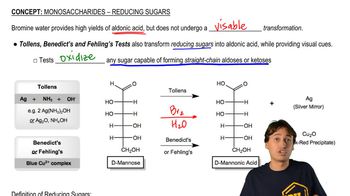
Reducing sugars are carbohydrates that can donate electrons to other molecules, typically due to the presence of a free aldehyde or ketone group. This property allows them to reduce certain chemical reagents, such as Benedict's or Fehling's solution. Gentiobiose, a disaccharide composed of two glucose units, has a free anomeric carbon that can participate in this reduction, classifying it as a reducing sugar.
Video consigliato:
08:42
Reducing Sugars

Mutarotation

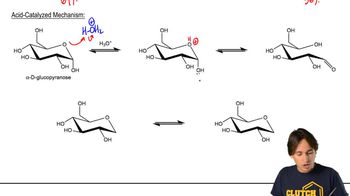
Mutarotation is the change in optical rotation that occurs when an anomeric carbon in a sugar molecule interconverts between its alpha and beta forms in solution. This process is significant for sugars with a free anomeric carbon, as it leads to a dynamic equilibrium between different anomeric forms. Gentiobiose can undergo mutarotation due to its free anomeric carbon, resulting in a change in its optical activity over time.
Video consigliato:
03:06
Mechanism

Anomeric Carbon

The anomeric carbon is the carbon atom in a sugar that is bonded to two oxygen atoms, one of which is part of a hydroxyl group and the other is part of a ring structure. This carbon is crucial in determining the reducing properties of sugars and their ability to mutarotate. In gentiobiose, the anomeric carbon is involved in the glycosidic bond formation, influencing its reactivity and behavior in solution.
Video consigliato:
02:12
Carbonation of Grignard Reagents
Pratica correlata
Domanda del libro di testo

Cellulose is converted to cellulose acetate by treatment with acetic anhydride and pyridine. Cellulose acetate is soluble in common organic solvents, and it is easily dissolved and spun into fibers. Show the structure of cellulose acetate.

149
views
Domanda del libro di testo

Draw the structures of the individual mutarotating α and β anomers of maltose.

927
views
Domanda del libro di testo

Give an equation to show the reduction of Tollens reagent by maltose.

1003
views
Domanda del libro di testo

Trehalose is a nonreducing disaccharide (C12H22O11) isolated from the poisonous mushroom Amanita muscaria. Treatment with an α-glucosidase converts trehalose to two molecules of glucose, but no reaction occurs when trehalose is treated with a β-glucosidase. When trehalose is methylated by dimethyl sulfate in mild base and then hydrolyzed, the only product is 2,3,4,6-tetra-O-methylglucose. Propose a complete structure and systematic name for trehalose.

670
views
Domanda del libro di testo

Raffinose is a trisaccharide (C18H32O16) isolated from cottonseed meal. Raffinose does not reduce Tollens reagent, and it does not mutarotate. Complete hydrolysis of raffinose gives D-glucose, D-fructose, and D-galactose. When raffinose is treated with invertase, the products are D-fructose and a reducing disaccharide called melibiose. Raffinose is unaffected by treatment with a β-galactosidase, but an α-galactosidase hydrolyzes it to D-galactose and sucrose. When raffinose is treated with dimethyl sulfate and base followed by hydrolysis, the products are 2,3,4-tri-O-methylglucose, 1,3,4,6-tetra-O-methylfructose, and 2,3,4,6-tetra-O-methylgalactose. Determine the complete structures of raffinose and melibiose, and give a systematic name for melibiose.

1467
views
Domanda del libro di testo

Does lactose mutarotate? Is it a reducing sugar? Explain. Draw the two anomeric forms of lactose

876
views