Ch. 23 - Carbohydrates and Nucleic Acids
Wade - Organic Chemistry 9th Edition
Wade9th EditionOrganic ChemistryISBN: 9780135213728Non è quello che usi tu?Cambia libro di testo
Capitolo 23, Problema 52f

Predict the products obtained when d-galactose reacts with each reagent.
(f) excess Ac2O and pyridine

Guida verificata passo dopo passo
1
Step 1: Understand the structure of D-galactose. D-galactose is an aldohexose, meaning it contains six carbon atoms with an aldehyde group at the first carbon and hydroxyl groups (-OH) on the remaining carbons.
Step 2: Recognize the role of the reagents. Ac2O (acetic anhydride) in the presence of pyridine acts as an acetylating agent. It reacts with hydroxyl groups (-OH) to form acetate esters (-OCOCH3). Pyridine serves as a base to neutralize the acidic byproducts of the reaction.
Step 3: Identify the reactive sites on D-galactose. The hydroxyl groups on carbons 2, 3, 4, and 6, as well as the hydroxyl group of the hemiacetal (if in cyclic form), are all potential sites for acetylation. The aldehyde group (if in open-chain form) does not react under these conditions.
Step 4: Predict the reaction outcome. In the presence of excess Ac2O, all hydroxyl groups on D-galactose will be acetylated, resulting in a fully acetylated derivative. If D-galactose is in its cyclic form, the hydroxyl group on the anomeric carbon (C1) will also be acetylated.
Step 5: Write the general structure of the product. The product will be a penta-acetate derivative of D-galactose, where each hydroxyl group is replaced by an acetate group (-OCOCH3). The stereochemistry of the sugar remains unchanged during this reaction.

Risposta video verificata per un problema simile:

Questa soluzione video è stata consigliata dai nostri tutor come utile per risolvere questo problema.

Concetti chiave

Ecco i concetti essenziali che devi comprendere per rispondere correttamente alla domanda.

Acetylation

Acetylation is a chemical reaction that introduces an acetyl group (C2H3O) into a molecule. In the context of carbohydrates like d-galactose, this process typically involves the reaction of the hydroxyl groups with acetic anhydride (Ac2O) in the presence of a base such as pyridine. This modification can enhance the solubility and stability of sugars, making them more amenable to further chemical transformations.
Video consigliato:
Percorso guidato
0:37
The Citric Acid Cycle Example 1

Pyridine as a Catalyst

Pyridine is often used as a catalyst or solvent in organic reactions due to its basicity and ability to stabilize charged intermediates. In the acetylation of d-galactose, pyridine helps to deprotonate the hydroxyl groups, facilitating the nucleophilic attack on the acetyl group from acetic anhydride. This results in the formation of acetylated derivatives of the sugar.
Video consigliato:
Percorso guidato
2:10
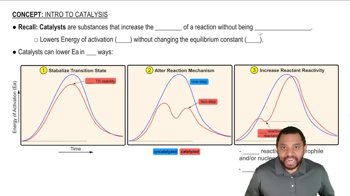
Introduction to Catalysis Concept 1

Stereochemistry of Sugars

Stereochemistry refers to the spatial arrangement of atoms in molecules and is crucial in understanding the behavior of sugars like d-galactose. The specific configuration of the hydroxyl groups in d-galactose influences how it reacts with reagents. When acetylation occurs, the stereochemical integrity of the sugar can affect the final product's properties and reactivity, making it essential to consider during product prediction.
Video consigliato:
08:42
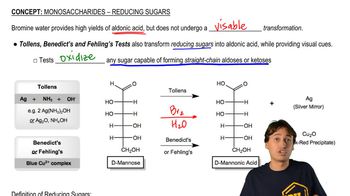
Reducing Sugars