Ch. 24 - Amino Acids, Peptides, and Proteins
Wade - Organic Chemistry 9th Edition
Wade9th EditionOrganic ChemistryISBN: 9780135213728Non è quello che usi tu?Cambia libro di testo
Capitolo 24, Problema 29e

Predict the products of the following reactions.
(e)

Guida verificata passo dopo passo
1
Step 1: Identify the functional group in the starting material. The given compound is a ketone, specifically 2-butanone, with a carbonyl group (C=O) as the reactive site.
Step 2: Analyze the reagents provided. The reaction involves NH₃ (ammonia), HCN (hydrogen cyanide), and H₂O (water). This suggests a cyanohydrin formation followed by hydrolysis.
Step 3: Predict the first step of the reaction. The carbonyl group reacts with HCN to form a cyanohydrin. The nucleophilic attack of the cyanide ion (CN⁻) on the carbonyl carbon generates a hydroxyl group (-OH) and a nitrile group (-CN) attached to the same carbon.
Step 4: Predict the second step of the reaction. The cyanohydrin undergoes hydrolysis in the presence of water, converting the nitrile group (-CN) into a carboxylic acid (-COOH). This results in the formation of an α-hydroxycarboxylic acid.
Step 5: Summarize the product. The final product is an α-hydroxycarboxylic acid derived from 2-butanone, where the hydroxyl group (-OH) and carboxylic acid group (-COOH) are attached to the same carbon atom.

Risposta video verificata per un problema simile:

Questa soluzione video è stata consigliata dai nostri tutor come utile per risolvere questo problema.
Durata del video:
2m

Concetti chiave

Ecco i concetti essenziali che devi comprendere per rispondere correttamente alla domanda.

Nucleophilic Addition Reactions

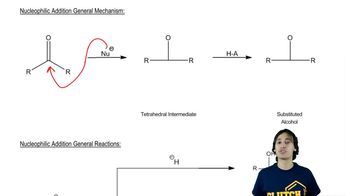
Nucleophilic addition reactions involve the attack of a nucleophile, such as ammonia (NH3) or cyanide (HCN), on an electrophilic carbon atom, typically found in carbonyl compounds. This reaction results in the formation of a new bond between the nucleophile and the carbon, leading to the generation of an intermediate that can further react to yield various products.
Video consigliato:
08:27
Nucleophilic Addition

Amino Acids and Their Reactions

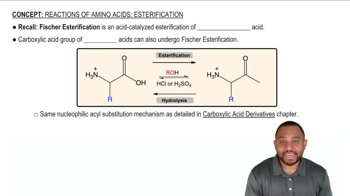
Amino acids are organic compounds that contain both an amino group and a carboxylic acid group. In the presence of nucleophiles like NH3 or HCN, amino acids can undergo reactions that modify their functional groups, potentially leading to the formation of new compounds such as amines or α-amino nitriles, depending on the reaction conditions.
Video consigliato:
Percorso guidato
1:21
Reactions of Amino Acids: Esterification Concept 1

Hydrolysis of Nitriles

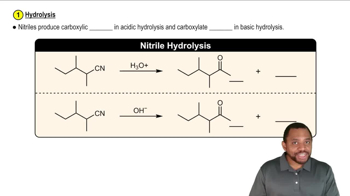
Hydrolysis of nitriles involves the reaction of nitriles with water, often in the presence of an acid or base, to convert them into carboxylic acids or amides. This reaction is significant in organic synthesis as it allows for the transformation of nitrile intermediates, which can be formed during nucleophilic addition reactions, into more functionalized products.
Video consigliato:
Percorso guidato
1:09
Review of Nitriles Concept 6