Ch. 24 - Amino Acids, Peptides, and Proteins
Wade - Organic Chemistry 9th Edition
Wade9th EditionOrganic ChemistryISBN: 9780135213728Non è quello che usi tu?Cambia libro di testo
Capitolo 24, Problema 12c

Show how you would use a Strecker synthesis to make
(c) aspartic acid.

Guida verificata passo dopo passo
1
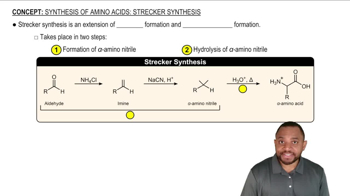
Identify the starting materials for the Strecker synthesis. Strecker synthesis involves the reaction of an aldehyde (or ketone), ammonia (NH₃), and hydrogen cyanide (HCN) to form an α-amino nitrile, which is then hydrolyzed to produce an α-amino acid. For aspartic acid, the aldehyde should have a structure that leads to the desired amino acid upon synthesis.
Choose the appropriate aldehyde. Aspartic acid has a carboxylic acid group on both the α and β carbons. Therefore, the starting aldehyde should be oxaloacetaldehyde (CHO-CH₂-COOH), which contains the necessary carbon skeleton.
React the aldehyde with ammonia (NH₃) and hydrogen cyanide (HCN). This step forms an α-amino nitrile intermediate. The reaction mechanism involves the nucleophilic addition of HCN to the aldehyde, followed by the reaction of the resulting imine with NH₃ to form the α-amino nitrile.
Hydrolyze the α-amino nitrile. Treat the α-amino nitrile with aqueous acid (H₃O⁺) or base (OH⁻) to hydrolyze the nitrile group (-C≡N) into a carboxylic acid (-COOH). This step converts the intermediate into aspartic acid.
Verify the structure of the product. Ensure that the final product has the correct structure of aspartic acid, which is HOOC-CH(NH₂)-CH₂-COOH, with both carboxylic acid groups and the amino group in the correct positions.

Risposta video verificata per un problema simile:

Questa soluzione video è stata consigliata dai nostri tutor come utile per risolvere questo problema.
Durata del video:
2m

Concetti chiave

Ecco i concetti essenziali che devi comprendere per rispondere correttamente alla domanda.

Strecker Synthesis

Strecker synthesis is a method for synthesizing amino acids through the reaction of an aldehyde with ammonia and hydrogen cyanide. This process involves the formation of an α-amino nitrile intermediate, which can be hydrolyzed to yield the corresponding amino acid. It is particularly useful for producing α-amino acids, such as aspartic acid, from simple starting materials.
Video consigliato:
Percorso guidato
1:39
Synthesis of Amino Acids: Strecker Synthesis Concept 1

Amino Acids

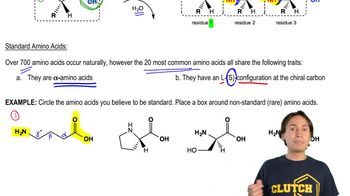
Amino acids are organic compounds that serve as the building blocks of proteins. Each amino acid contains a central carbon atom bonded to an amino group, a carboxyl group, a hydrogen atom, and a variable side chain (R group) that determines its properties. Aspartic acid is a non-essential amino acid that plays a critical role in the biosynthesis of proteins and is involved in various metabolic processes.
Video consigliato:
09:36
Standard Amino Acids

Hydrolysis

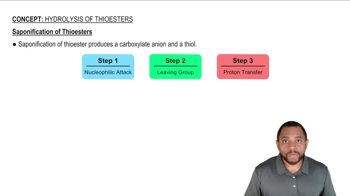
Hydrolysis is a chemical reaction involving the breakdown of a compound by water. In the context of Strecker synthesis, hydrolysis converts the α-amino nitrile intermediate into the corresponding amino acid. This step is crucial for obtaining the final product, as it ensures the transformation of the nitrile functional group into the carboxylic acid group characteristic of amino acids.
Video consigliato:
Percorso guidato
1:00
Hydrolysis of Thioesters Concept 2