Indietro
Problema 16k,l
Draw the structure that corresponds with each name.
k. cyclobutylcyclohexane
l. cis-1-bromo-3-chlorocyclohexane
Problema 17a
Which of the following cycloalkanes are capable of geometric (cis-trans) isomerism? Draw the cis and trans isomers.
a. 3-ethyl-1,1-dimethylcyclohexane
Problema 17b
Which of the following cycloalkanes are capable of geometric (cis-trans) isomerism? Draw the cis and trans isomers.
b. 1-ethyl-3-methylcycloheptane
Problema 17c
Which of the following cycloalkanes are capable of geometric (cis-trans) isomerism? Draw the cis and trans isomers.
c. 1-ethyl-3-methylcyclopentane
Problema 19
The heat of combustion of cis-1,2-dimethylcyclopropane is larger than that of the trans isomer. Which isomer is more stable? Use drawings to explain this difference in stability.
Problema 20
trans-1,2-Dimethylcyclobutane is more stable than cis-1,2-dimethylcyclobutane, but cis-1,3-dimethylcyclobutane is more stable than trans-1,3-dimethylcyclobutane. Use drawings to explain these observations.
Problema 21
The cyclohexane chair shown in Figure 3-22 has the headrest to the right and the footrest to the left. Draw a cyclohexane chair with its axial and equatorial bonds, showing the headrest to the left and the footrest to the right.
Problema 22a
Draw 1,2,3,4,5,6-hexamethylcyclohexane with all the methyl groups
a. in axial positions.
Problema 22b
Draw 1,2,3,4,5,6-hexamethylcyclohexane with all the methyl groups
b. in equatorial positions.
Problema 23
Draw a Newman projection, similar to Figure 3-25 down the C1—C6 bond in the equatorial conformation of methylcyclohexane. Show that the equatorial methyl group is also anti to C5. (Using your models will help.)
<IMAGE>
Problema 24
Table 3-6 shows that the axial–equatorial energy difference for methyl, ethyl, and isopropyl groups increases gradually: 7.6, 7.9, and 8.8 kJ/mol (1.8, 1.9, and 2.1 kcal/mol). The tert-butyl group jumps to an energy difference of 23 kJ/mol (5.4 kcal/mol), over twice the value for the isopropyl group. Draw pictures of the axial conformations of isopropylcyclohexane and tert-butylcyclohexane, and explain why the tert-butyl substituent experiences such a large increase in axial energy over the isopropyl group.

Problema 25a
Draw the most stable conformation of
a. ethylcyclohexane.
Problema 25b
Draw the most stable conformation of
b. 3-isopropyl-1,1-dimethylcyclohexane.
Problema 25c
Draw the most stable conformation of
c. cis-1-tert-butyl-4-isopropylcyclohexane.
Problema 26c,d
Name the following compounds. Remember that two up bonds are cis; two down bonds are cis; one up bond and one down bond are trans.
(c)
(d)
Problema 26e,f
Name the following compounds. Remember that two up bonds are cis; two down bonds are cis; one up bond and one down bond are trans.
(e)
(f)
Problema 27
a. Draw both chair conformations of cis-1,4-dimethylcyclohexane, and determine which conformer is more stable.
b. Repeat for the trans isomer.
c. Predict which isomer (cis or trans) is more stable.
Problema 28
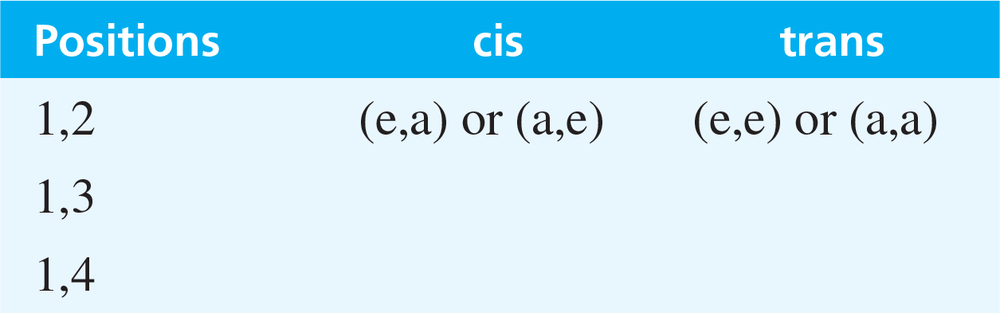
Use your results from Problem 3-27 to complete the following table. Each entry shows the positions of two groups arranged as shown. For example, two groups that are trans on adjacent carbons (trans-1,2) must be both equatorial (e,e) or both axial (a,a).
Problema 29a,b
Draw the two chair conformations of each of the following substituted cyclohexanes. In each case, label the more stable conformation.
a. cis-1-ethyl-2-methylcyclohexane
b. trans-1,2-diethylcyclohexane
Problema 29c,d
Draw the two chair conformations of each of the following substituted cyclohexanes. In each case, label the more stable conformation.]
c. cis-1-ethyl-4-isopropylcyclohexane
d. trans-1-ethyl-4-methylcyclohexane
Problema 30a
Draw the most stable conformation of
a. cis-1-tert-butyl-3-ethylcyclohexane.
Problema 30b
Draw the most stable conformation of
b. trans-1-tert-butyl-2-methylcyclohexane.
Problema 30c
Draw the most stable conformation of
c. trans-1-tert-butyl-3-(1,1-dimethylpropyl)cyclohexane.
Problema 31a,b
Name the following compounds.
(a)
(b)
Problema 31c,d
Name the following compounds.
(c)
(d)
Problema 32
Use your models to do a chair–chair interconversion on each ring of the conformation of cis-decalin shown in Figure 3-27. Draw the conformation that results.
Problema 33a
a. There are 18 isomeric alkanes of molecular formula C8H18. Draw and name any eight of them.
Problema 33b
Draw and name the six isomeric cyclopentanes of molecular formula C7H14. These will include four constitutional isomers, of which two show geometric (cis-trans) stereoisomerism.
Problema 34a
Which of the following structures represent the same compound? Which ones represent different compounds?
(a)
Problema 34b
Which of the following structures represent the same compound? Which ones represent different compounds?
(b)