
Ch.4 - The Study of Chemical Reactions
Wade - Organic Chemistry 9th Edition
Wade9th EditionOrganic ChemistryISBN: 9780135213728Non è quello che usi tu?Cambia libro di testo
Capitolo 4, Problema 14b,c

•CH3 + HCl → CH4 + Cl•
b. What is the activation energy for this reverse reaction?
c. What is the heat of reaction (ΔH°) for this reverse reaction?

Guida verificata passo dopo passo
1
Step 1: Understand the reaction. The given reaction is a radical reaction where a methyl radical (•CH3) reacts with HCl to form methane (CH4) and a chlorine radical (Cl•). The reverse reaction involves CH4 and Cl• reacting to form •CH3 and HCl.
Step 2: To determine the activation energy for the reverse reaction, recall that the activation energy (Ea) for a reverse reaction can be calculated using the relationship: Ea(reverse) = Ea(forward) - ΔH°. Here, Ea(forward) is the activation energy for the forward reaction, and ΔH° is the enthalpy change of the reaction.
Step 3: To calculate ΔH° for the reverse reaction, use the bond dissociation energies (BDEs) of the bonds involved. For the forward reaction, the bonds broken and formed are: (1) Breaking the H-Cl bond and (2) Forming the C-H bond. ΔH° = Σ(BDE of bonds broken) - Σ(BDE of bonds formed). For the reverse reaction, the sign of ΔH° will be opposite to that of the forward reaction.
Step 4: Look up the bond dissociation energies (BDEs) for the H-Cl bond and the C-H bond. Use these values to calculate ΔH° for the forward reaction, then reverse the sign to find ΔH° for the reverse reaction.
Step 5: Substitute the values of Ea(forward) and ΔH° (calculated in the previous steps) into the equation Ea(reverse) = Ea(forward) - ΔH° to find the activation energy for the reverse reaction.

Risposta video verificata per un problema simile:

Questa soluzione video è stata consigliata dai nostri tutor come utile per risolvere questo problema.
Durata del video:
5m

Concetti chiave

Ecco i concetti essenziali che devi comprendere per rispondere correttamente alla domanda.

Activation Energy

Activation energy is the minimum energy required for a chemical reaction to occur. It represents the energy barrier that reactants must overcome to transform into products. In the context of the reverse reaction, understanding the activation energy helps predict the rate at which the reaction can proceed and is crucial for calculating the energy changes involved.
Video consigliato:
08:30
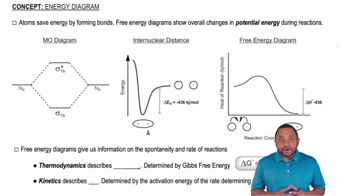
Introduction to free energy diagrams.

Heat of Reaction (ΔH°)

The heat of reaction, or ΔH°, is the change in enthalpy that occurs during a chemical reaction at constant pressure. It indicates whether a reaction is exothermic (releases heat) or endothermic (absorbs heat). For the reverse reaction, ΔH° can be determined by the difference in energy between the products and reactants, providing insight into the energy dynamics of the process.
Video consigliato:
03:01
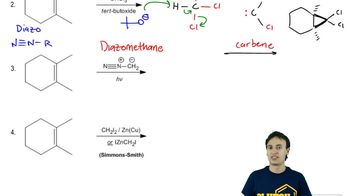
Reaction with diazomethane and light or heat.

Reaction Mechanism

A reaction mechanism is a step-by-step description of the pathway taken by reactants to form products. It includes the sequence of elementary steps, intermediates, and transition states involved in the reaction. Understanding the mechanism is essential for analyzing the activation energy and heat of reaction, as it reveals how the reaction proceeds and the energy changes at each stage.
Video consigliato:
02:16
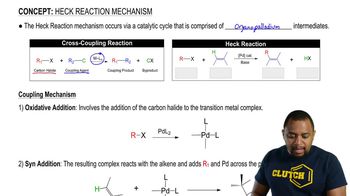
Heck Reaction Mechanism
Pratica correlata
Domanda del libro di testo

When a small piece of platinum is added to a mixture of ethene and hydrogen, the ­following reaction occurs: Ethene

Doubling the concentration of hydrogen has no effect on the reaction rate. Doubling the concentration of ethene also has no effect.

a. What is the kinetic order of this reaction with respect to ethene? With respect to hydrogen? What is the overall order?

1825
views
Domanda del libro di testo

When a small piece of platinum is added to a mixture of ethene and hydrogen, the ­following reaction occurs:

Doubling the concentration of hydrogen has no effect on the reaction rate. Doubling the concentration of ethene also has no effect.

b. Write the unusual rate equation for this reaction.

c. Explain this strange rate equation, and suggest what one might do to accelerate the reaction.

801
views
Domanda del libro di testo

The bromination of methane proceeds through the following steps:

a. Draw a complete reaction-energy diagram for this reaction.

b. Label the rate-limiting step.

1850
views
Domanda del libro di testo

Draw the reaction-energy diagram for the following reverse reaction:

•CH3 + HCl → CH4 + Cl•

2076
views
Domanda del libro di testo

Draw a reaction-energy diagram for the following reaction:

•CH3 + Cl2 → CH3Cl + Cl•

The activation energy is 4 kJ/mol (1 kcal/mol), and the overall ΔH° for the reaction is –110 kJ/mol (–27 kcal/mol).

1285
views
Domanda del libro di testo

•CH3 + Cl2 → CH3Cl + Cl•

The activation energy is 4 kJ/mol (1 kcal/mol), and the overall ΔH° for the reaction is –110 kJ/mol (–27 kcal/mol).

b. Give the equation for the reverse reaction.

c. What is the activation energy for the reverse reaction?

1971
views