Ch.4 - The Study of Chemical Reactions
Wade - Organic Chemistry 9th Edition
Wade9th EditionOrganic ChemistryISBN: 9780135213728Non è quello che usi tu?Cambia libro di testo
Capitolo 4, Problema 41a

Use bond-dissociation enthalpies (Table 4-2, p. 167) to calculate values of ΔH° for the following reactions.
a. CH3—CH3 + I2 → CH3CH2I + HI

Guida verificata passo dopo passo
1
Step 1: Understand the problem. The goal is to calculate the enthalpy change (ΔH°) for the given reaction using bond-dissociation enthalpies. Bond-dissociation enthalpy is the energy required to break a bond in a molecule into its individual atoms in the gas phase.
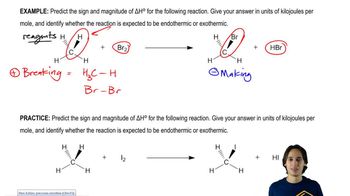
Step 2: Write down the bonds broken and formed in the reaction. In the given reaction, the bonds broken are one C-H bond in CH3—CH3 and one I-I bond in I2. The bonds formed are one C-I bond in CH3CH2I and one H-I bond in HI.
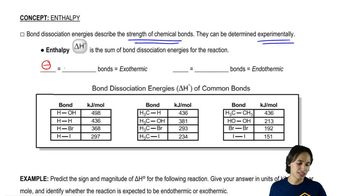
Step 3: Use the bond-dissociation enthalpy table to find the values for each bond. Look up the bond-dissociation enthalpy for C-H, I-I, C-I, and H-I bonds in the provided table (TABLE 4-2, p. 167). Ensure you use the correct values for each bond.
Step 4: Calculate the total energy required to break the bonds. Add the bond-dissociation enthalpies for the bonds broken (C-H and I-I). This represents the energy input for the reaction.
Step 5: Calculate the total energy released when new bonds are formed. Add the bond-dissociation enthalpies for the bonds formed (C-I and H-I). Subtract the energy released from the energy input to determine ΔH° for the reaction.

Risposta video verificata per un problema simile:

Questa soluzione video è stata consigliata dai nostri tutor come utile per risolvere questo problema.
Durata del video:
3m

Concetti chiave

Ecco i concetti essenziali che devi comprendere per rispondere correttamente alla domanda.

Bond-Dissociation Enthalpy

Bond-dissociation enthalpy (BDE) is the energy required to break a specific bond in a molecule, resulting in the formation of two radicals. It is a crucial concept in thermochemistry, as it helps predict the stability of molecules and the energy changes during chemical reactions. BDE values are typically provided in kilojoules per mole (kJ/mol) and vary depending on the type of bond and the molecular environment.
Video consigliato:
04:09
How to calculate enthalpy using bond dissociation energies.

Enthalpy Change (ΔH°)

Enthalpy change (ΔH°) refers to the heat content change of a system at constant pressure during a chemical reaction. It can be calculated using the bond-dissociation enthalpies of the reactants and products. The formula ΔH° = ΣBDE(reactants) - ΣBDE(products) allows chemists to determine whether a reaction is exothermic (releases heat) or endothermic (absorbs heat).
Video consigliato:
04:38
Calculating Enthalpies

Reaction Mechanism

A reaction mechanism describes the step-by-step sequence of elementary reactions by which overall chemical change occurs. Understanding the mechanism helps in predicting the products and the energy changes involved. In the given reaction, the mechanism involves the breaking of C-H and I-I bonds and the formation of C-I and H-I bonds, which is essential for calculating the overall enthalpy change.
Video consigliato:
02:16
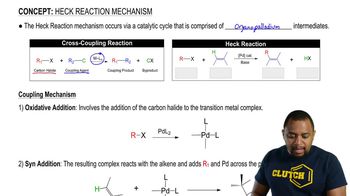
Heck Reaction Mechanism