Use the information in Table 4-2 (p. 167) to rank the following radicals in decreasing order of stability.
Ch.4 - The Study of Chemical Reactions
Capitolo 4, Problema 41d
Use bond-dissociation enthalpies (Table 4-2, p. 167) to calculate values of ΔH° for the following reactions.
d. CH3CH2CH3 + H2 → CH3CH3 + CH4
Guida verificata passo dopo passo1
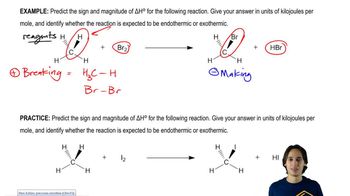
Identify the bonds broken and formed in the reaction. In this case, the bonds broken are one C-H bond in CH3CH2CH3 (propane) and one H-H bond in H2. The bonds formed are one C-H bond in CH3CH3 (ethane) and one C-H bond in CH4 (methane).
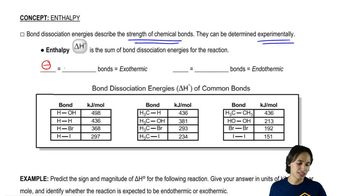
Refer to the bond-dissociation enthalpy table (TABLE 4-2, p. 167) to find the bond-dissociation enthalpy values for each bond involved. For example, the bond-dissociation enthalpy for a C-H bond and an H-H bond will be listed in the table.
Calculate the total energy required to break the bonds. This is done by summing the bond-dissociation enthalpy values for the bonds broken (C-H in propane and H-H in H2).
Calculate the total energy released when the new bonds are formed. This is done by summing the bond-dissociation enthalpy values for the bonds formed (C-H in ethane and C-H in methane).
Determine the overall enthalpy change (ΔH°) for the reaction by subtracting the total energy released (bonds formed) from the total energy required (bonds broken). Use the formula: ΔH° = Σ(bonds broken) - Σ(bonds formed).

Risposta video verificata per un problema simile:
Questa soluzione video è stata consigliata dai nostri tutor come utile per risolvere questo problema.
Durata del video:
5mConcetti chiave
Ecco i concetti essenziali che devi comprendere per rispondere correttamente alla domanda.
Bond-Dissociation Enthalpy
Bond-dissociation enthalpy (BDE) is the energy required to break a specific bond in a molecule, resulting in the formation of free radicals. It is a crucial concept in thermochemistry, as it helps predict the stability of molecules and the energy changes during chemical reactions. BDE values are typically expressed in kilojoules per mole (kJ/mol) and vary depending on the type of bond and the molecular environment.
Video consigliato:
How to calculate enthalpy using bond dissociation energies.
Enthalpy Change (ΔH°)
The enthalpy change (ΔH°) of a reaction is the difference in enthalpy between the products and reactants under standard conditions. It indicates whether a reaction is exothermic (releases heat, ΔH° < 0) or endothermic (absorbs heat, ΔH° > 0). Calculating ΔH° using bond-dissociation enthalpies involves summing the BDEs of bonds broken in the reactants and subtracting the BDEs of bonds formed in the products.
Video consigliato:
Calculating Enthalpies
Reaction Mechanism
A reaction mechanism describes the step-by-step sequence of elementary reactions by which overall chemical change occurs. Understanding the mechanism is essential for predicting the products and energy changes in a reaction. In the context of the given reaction, recognizing the bonds involved and their respective BDEs allows for accurate calculation of the overall enthalpy change, reflecting the energy dynamics of the process.
Video consigliato:
Heck Reaction Mechanism
Pratica correlata
Domanda del libro di testo
870
views
Domanda del libro di testo
Use bond-dissociation enthalpies (Table 4-2, p. 167) to calculate values of ΔH° for the following reactions.
a. CH3—CH3 + I2 → CH3CH2I + HI
1574
views
Domanda del libro di testo
Use bond-dissociation enthalpies (Table 4-2, p. 167) to calculate values of ΔH° for the following reactions.
c. (CH3)3C—OH + HCl → (CH3)3C—Cl + H2O
1225
views
Domanda del libro di testo
For each alkane,
1. draw all the possible monochlorinated derivatives.
a. Cyclopentane
b. Methylcyclopentane
920
views
Domanda del libro di testo
For each alkane,
2. determine whether free-radical chlorination would be a good way to make any of these monochlorinated derivatives. Will the reaction give mostly one major product?
a. Cyclopentane
b. Methylcyclopentane
932
views
Domanda del libro di testo
Use bond-dissociation enthalpies (Table 4-2, p. 167) to calculate values of ΔH° for the following reactions.
b. CH3CH2Cl + HI → CH3CH2I + HCl
1416
views