Ch.5 - Stereochemistry
Wade - Organic Chemistry 9th Edition
Wade9th EditionOrganic ChemistryISBN: 9780135213728Non è quello che usi tu?Cambia libro di testo
Capitolo 5, Problema 9a

A solution of 0.50 g of (−)-epinephrine (see Figure 5-16) dissolved in 10.0 mL of dilute aqueous HCl was placed in a 20-cm polarimeter tube. Using the sodium D line, the rotation was found to be −5.1° at 25 °C. Determine the specific rotation of epinephrine.
<IMAGE>

Guida verificata passo dopo passo
1
Understand the formula for specific rotation: The specific rotation [α] is calculated using the formula: [α] = (α_obs) / (l × c), where α_obs is the observed rotation, l is the path length in decimeters (dm), and c is the concentration in g/mL.
Convert the path length to decimeters: The given path length is 20 cm. Since 1 dm = 10 cm, convert the path length to decimeters by dividing 20 cm by 10. This gives l = 2.0 dm.
Calculate the concentration: The concentration c is the mass of the solute (in grams) divided by the volume of the solution (in mL). Here, the mass of (−)-epinephrine is 0.50 g, and the volume of the solution is 10.0 mL. Use the formula c = rac{mass}{volume} to calculate c.
Substitute the values into the specific rotation formula: Use the observed rotation α_obs = −5.1°, the path length l = 2.0 dm, and the concentration c (calculated in the previous step) in the formula [α] = rac{α_obs}{l × c}.
Simplify the expression to determine the specific rotation: Perform the division to calculate the specific rotation [α] in units of degrees·mL/(g·dm). Ensure the sign of the rotation is preserved (negative in this case).

Risposta video verificata per un problema simile:

Questa soluzione video è stata consigliata dai nostri tutor come utile per risolvere questo problema.
Durata del video:
1m

Concetti chiave

Ecco i concetti essenziali che devi comprendere per rispondere correttamente alla domanda.

Specific Rotation

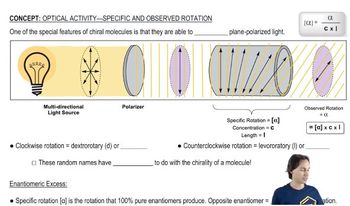
Specific rotation is a property of chiral compounds that quantifies their ability to rotate plane-polarized light. It is defined as the observed rotation (in degrees) divided by the concentration of the solution (in grams per milliliter) and the path length of the polarimeter tube (in decimeters). The formula is [α] = α / (c × l), where [α] is the specific rotation, α is the observed rotation, c is the concentration, and l is the path length.
Video consigliato:
05:43
Specific rotation vs. observed rotation.

Chirality and Optical Activity

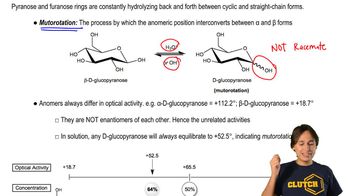
Chirality refers to the geometric property of a molecule that makes it non-superimposable on its mirror image, often leading to the existence of enantiomers. These enantiomers can rotate plane-polarized light in opposite directions, a phenomenon known as optical activity. In the case of epinephrine, its specific rotation indicates how it interacts with polarized light, which is crucial for understanding its stereochemistry.
Video consigliato:
08:17
Mutorotation and Optical Activity

Polarimetry

Polarimetry is an analytical technique used to measure the angle of rotation of polarized light as it passes through a sample solution. The degree of rotation is influenced by the concentration of the optically active substance, the wavelength of light used, and the length of the sample tube. This technique is essential for determining the specific rotation of chiral compounds like epinephrine, providing insights into their concentration and purity.
Pratica correlata
Domanda del libro di testo
Write structural formulas for the following compounds (includes both old- and new-style names). (j) vinylacetylene (k) (S)-3-methyl-1-penten-4-yne
1029
views

Domanda del libro di testo

A chiral sample gives a rotation that is close to 180°. How can one tell whether this rotation is +180° or -180°?

2121
views
1
rank
Domanda del libro di testo

In Problem 5-3, you drew the enantiomers for a number of chiral compounds. Now go back and designate each asymmetric carbon atom as either (R) or (S).

(e) chlorocyclohexane

(f) cis-1,2-dichlorocyclobutane

1552
views
Domanda del libro di testo

When optically pure (R)-2-bromobutane is heated with water, butan-2-ol is the product. The reaction forms twice as much (S)-butan-2-ol as (R)-butan-2-ol. Calculate the e.e. and the specific rotation expected for the product.

1199
views
Domanda del libro di testo

A solution of 2.0 g of (+)-glyceraldehyde, HOCH2CHOHCHO, in 10.0 mL of water was placed in a 100-mm cell. Using the sodium D line, a rotation of +1.74° was found at 25 °C. Determine the specific rotation of (+)-glyceraldehyde

2047
views
1
rank
Domanda del libro di testo

If you had the two enantiomers of carvone in unmarked bottles, could you use just your nose and a polarimeter to determine

a. whether it is the (+) or (−) enantiomer that smells like spearmint

b. whether it is the (R) or (S) enantiomer that smells like spearmint?

c. With the information given in the drawings of carvone above, what can you add to your answers to (a) and (b)?

2573
views