Ch.5 - Stereochemistry
Wade - Organic Chemistry 9th Edition
Wade9th EditionOrganic ChemistryISBN: 9780135213728Non è quello che usi tu?Cambia libro di testo
Capitolo 5, Problema 7e,f

In Problem 5-3, you drew the enantiomers for a number of chiral compounds. Now go back and designate each asymmetric carbon atom as either (R) or (S).
(e) chlorocyclohexane
(f) cis-1,2-dichlorocyclobutane

Guida verificata passo dopo passo
1
Step 1: Understand the problem. You are tasked with assigning the configuration (R or S) to each asymmetric carbon atom in the given compounds: chlorocyclohexane and cis-1,2-dichlorocyclobutane. The images provided are not directly related to the problem but serve as examples of stereochemistry in cyclic compounds.
Step 2: Recall the Cahn-Ingold-Prelog priority rules. To assign R or S configuration, you need to: (a) Assign priorities to the substituents attached to the chiral carbon based on atomic number, (b) Orient the molecule so the lowest priority group is pointing away from you, and (c) Determine the order of the remaining groups (clockwise for R, counterclockwise for S).
Step 3: For chlorocyclohexane, identify the chiral carbon. The chiral carbon is the one bonded to four different groups: a chlorine atom, a hydrogen atom, and two different parts of the cyclohexane ring. Assign priorities based on atomic number (Cl > C > H). Orient the molecule and determine the configuration.
Step 4: For cis-1,2-dichlorocyclobutane, identify the two chiral carbons. Each carbon in the 1,2 positions is bonded to a chlorine atom, a hydrogen atom, and two different parts of the cyclobutane ring. Assign priorities for each chiral carbon (Cl > C > H). Orient the molecule and determine the configuration for each carbon.
Step 5: Verify your assignments by checking the spatial arrangement of the substituents and ensuring the lowest priority group is pointing away. Use the clockwise or counterclockwise rule to finalize the R or S designation for each chiral carbon.

Risposta video verificata per un problema simile:

Questa soluzione video è stata consigliata dai nostri tutor come utile per risolvere questo problema.
Durata del video:
6m

Concetti chiave

Ecco i concetti essenziali che devi comprendere per rispondere correttamente alla domanda.

Chirality

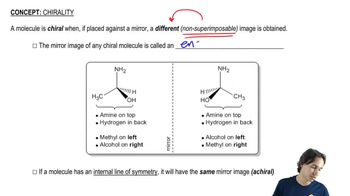
Chirality refers to the geometric property of a molecule that makes it non-superimposable on its mirror image. Chiral molecules typically contain one or more asymmetric carbon atoms, which are carbon atoms bonded to four different substituents. This property is crucial in organic chemistry as it affects the behavior of molecules in biological systems and their interactions with other chiral substances.
Video consigliato:
05:10
What is chirality?

R and S Nomenclature

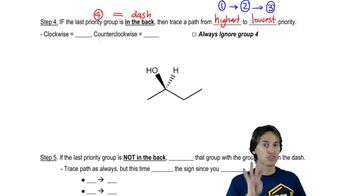
The R and S nomenclature system is used to assign configurations to chiral centers in molecules. To determine whether a chiral center is designated as (R) or (S), the substituents attached to the asymmetric carbon are ranked according to their atomic number. The orientation of the highest priority substituents, when viewed from a specific perspective, determines the designation: clockwise for (R) and counterclockwise for (S).
Video consigliato:
03:07
R and S Naming- Step 4

Cyclic Compounds and Stereochemistry

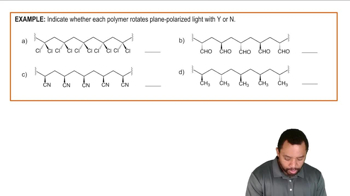
Cyclic compounds, such as cyclohexane and cyclobutane, can exhibit stereochemistry due to the arrangement of substituents around the ring. The presence of substituents in different orientations (cis or trans) can lead to different stereoisomers. Understanding the stereochemistry of cyclic compounds is essential for determining their reactivity and interactions, particularly in the context of chiral centers.
Video consigliato:
Percorso guidato
1:21
Polymer Stereochemistry Example 1