Ch.5 - Stereochemistry
Wade - Organic Chemistry 9th Edition
Wade9th EditionOrganic ChemistryISBN: 9780135213728Non è quello che usi tu?Cambia libro di testo
Capitolo 5, Problema 6

A solution of pure (S)-2-iodobutane ([α] = +15.90° ) in acetone is allowed to react with radioactive iodide, 131I-, until 1.0% of the iodobutane contains radioactive iodine. The specific rotation of this recovered iodobutane is found to be +15.58°. a. Determine the percentages of (R)- and (S)-2-iodobutane in the product mixture.

Guida verificata passo dopo passo
1
Identify the initial specific rotation of pure (S)-2-iodobutane, which is given as +15.90°.
Recognize that the specific rotation of the recovered iodobutane is +15.58°, indicating a mixture of (R)- and (S)-2-iodobutane.
Use the formula for enantiomeric excess (ee): ee = (observed specific rotation / specific rotation of pure enantiomer) * 100% to find the enantiomeric excess of the mixture.
Calculate the percentage of the major enantiomer (S)-2-iodobutane using the enantiomeric excess: %S = (ee + 100) / 2.
Determine the percentage of the minor enantiomer (R)-2-iodobutane: %R = 100 - %S.

Risposta video verificata per un problema simile:

Questa soluzione video è stata consigliata dai nostri tutor come utile per risolvere questo problema.
Durata del video:
5m

Concetti chiave

Ecco i concetti essenziali che devi comprendere per rispondere correttamente alla domanda.

Optical Activity and Specific Rotation

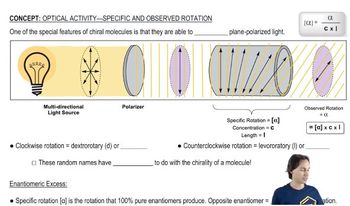
Optical activity refers to the ability of chiral compounds to rotate plane-polarized light. The specific rotation, denoted as [α], quantifies this rotation and is defined as the observed rotation divided by the concentration and path length. In this question, the specific rotation values of the pure and recovered iodobutane are crucial for determining the composition of the product mixture.
Video consigliato:
05:43
Specific rotation vs. observed rotation.

Chirality and Enantiomers

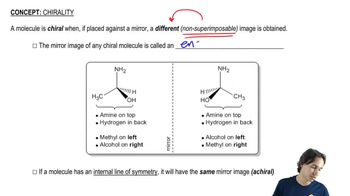
Chirality is a property of molecules that are non-superimposable on their mirror images, leading to the existence of enantiomers—two compounds that are mirror images of each other. In this case, (S)-2-iodobutane and (R)-2-iodobutane are enantiomers, and their relative proportions in the product mixture can be inferred from the specific rotation measurements and the extent of racemization during the reaction.
Video consigliato:
05:10
What is chirality?

Racemization and Reaction Kinetics

Racemization is the process by which one enantiomer is converted into its mirror image, resulting in a mixture of both enantiomers. The reaction kinetics, influenced by factors such as solvent and temperature, can affect the rate of racemization. In this scenario, the introduction of radioactive iodide and the resulting specific rotation provide insights into the extent of racemization and the final enantiomeric composition of the product.
Video consigliato:
08:51
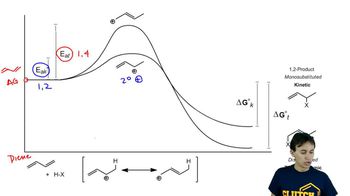
Kinetic vs. Thermodynamic Control
Pratica correlata
Domanda del libro di testo
b. Draw the six stereoisomers of octa-2,4,6-triene. Explain why there are only six stereoisomers, rather than the eight we might expect for a compound with three stereogenic double bonds.
1243
views

Domanda del libro di testo

Star (*) each asymmetric carbon atom in the following examples, and determine whether it has the (R) or (S) configuration.

(i)

878
views
Domanda del libro di testo

For each compound, determine whether the molecule has an internal mirror plane of symmetry. If it does, draw the mirror plane on a three-dimensional drawing of the molecule. If the molecule does not have an internal mirror plane, determine whether the structure is chiral.

(a) methane

(b) cis-1,2-dibromocyclobutane

(c) trans-1,2-dibromocyclobutane

1151
views
Domanda del libro di testo

For each compound, determine whether the molecule has an internal mirror plane of symmetry. If it does, draw the mirror plane on a three-dimensional drawing of the molecule. If the molecule does not have an internal mirror plane, determine whether the structure is chiral.

(d) 1,2-dichloropropane

(e)

1828
views
Domanda del libro di testo

Star (*) each asymmetric carbon atom in the following examples, and determine whether it has the (R) or (S) configuration.

(a)

(b)

1404
views
Domanda del libro di testo

For each compound, determine whether the molecule has an internal mirror plane of symmetry. If it does, draw the mirror plane on a three-dimensional drawing of the molecule. If the molecule does not have an internal mirror plane, determine whether the structure is chiral.

(h)

862
views