Ch.5 - Stereochemistry
Wade - Organic Chemistry 9th Edition
Wade9th EditionOrganic ChemistryISBN: 9780135213728Non è quello che usi tu?Cambia libro di testo
Capitolo 5, Problema 6a,b

Star (*) each asymmetric carbon atom in the following examples, and determine whether it has the (R) or (S) configuration.
(a) Molecular structure showing an asymmetric carbon atom with groups labeled for R and S configuration determination.
(b) Structural formula of a chiral carbon atom with attached groups, indicating R and S configurations.

Guida verificata passo dopo passo
1
Step 1: Identify the asymmetric carbon atom in each molecule. An asymmetric carbon is a carbon atom bonded to four different groups. In both molecules, the central carbon atom is bonded to four distinct groups, making it asymmetric.
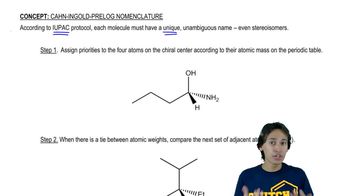
Step 2: Assign priorities to the substituents attached to the asymmetric carbon based on the Cahn-Ingold-Prelog priority rules. The rules state that the atom with the highest atomic number gets the highest priority. If two atoms are the same, consider the atoms directly bonded to them.
Step 3: Orient the molecule so that the lowest priority group (usually hydrogen) is pointing away from you. This ensures that you can correctly determine the configuration.
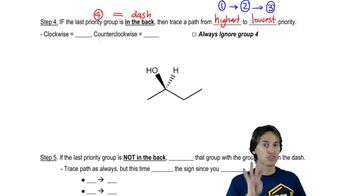
Step 4: Determine the order of the remaining three groups (1, 2, 3) based on their priorities. Trace a path from the highest priority group (1) to the second (2) and then to the third (3). If the path is clockwise, the configuration is (R). If the path is counterclockwise, the configuration is (S).
Step 5: Repeat the process for both molecules, ensuring that you carefully follow the priority rules and orientation guidelines to assign the correct (R) or (S) configuration for each asymmetric carbon.

Risposta video verificata per un problema simile:

Questa soluzione video è stata consigliata dai nostri tutor come utile per risolvere questo problema.
Durata del video:
7m

Concetti chiave

Ecco i concetti essenziali che devi comprendere per rispondere correttamente alla domanda.

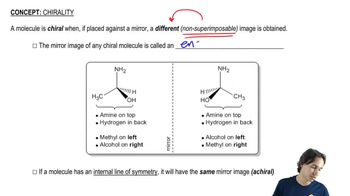
Chirality

Chirality refers to the geometric property of a molecule that makes it non-superimposable on its mirror image. A chiral molecule typically contains an asymmetric carbon atom, which is bonded to four different substituents. This property is crucial in organic chemistry as it affects the molecule's interactions and biological activity.
Video consigliato:
05:10
What is chirality?

R and S Configuration

The R and S configuration system is used to describe the spatial arrangement of substituents around a chiral center. To assign R or S, the substituents are ranked based on atomic number, with the highest priority assigned first. The configuration is determined by the orientation of the lowest priority group; if it is positioned at the back and the sequence of the other groups is clockwise, it is R; if counterclockwise, it is S.
Video consigliato:
03:07
R and S Naming- Step 4

Cahn-Ingold-Prelog Priority Rules

The Cahn-Ingold-Prelog priority rules are a set of guidelines used to assign priority to substituents attached to a chiral center. These rules state that higher atomic number atoms take precedence over lower ones, and in cases of ties, the next atoms in the substituent chain are considered. Understanding these rules is essential for accurately determining the R or S configuration of chiral molecules.
Video consigliato:
01:48
Why stereoisomers need their own naming system.
Pratica correlata
Domanda del libro di testo

In Problem 5-3, you drew the enantiomers for a number of chiral compounds. Now go back and designate each asymmetric carbon atom as either (R) or (S).

(a)

(b)

1970
views

Domanda del libro di testo
b. Draw the six stereoisomers of octa-2,4,6-triene. Explain why there are only six stereoisomers, rather than the eight we might expect for a compound with three stereogenic double bonds.
1243
views
Domanda del libro di testo

Star (*) each asymmetric carbon atom in the following examples, and determine whether it has the (R) or (S) configuration.

(i)

878
views
Domanda del libro di testo

For each compound, determine whether the molecule has an internal mirror plane of symmetry. If it does, draw the mirror plane on a three-dimensional drawing of the molecule. If the molecule does not have an internal mirror plane, determine whether the structure is chiral.

(d) 1,2-dichloropropane

(e)

1828
views
Domanda del libro di testo

For each compound, determine whether the molecule has an internal mirror plane of symmetry. If it does, draw the mirror plane on a three-dimensional drawing of the molecule. If the molecule does not have an internal mirror plane, determine whether the structure is chiral.

(h)

862
views
Domanda del libro di testo
A solution of pure (S)-2-iodobutane ([α] = +15.90° ) in acetone is allowed to react with radioactive iodide, 131I-, until 1.0% of the iodobutane contains radioactive iodine. The specific rotation of this recovered iodobutane is found to be +15.58°. a. Determine the percentages of (R)- and (S)-2-iodobutane in the product mixture.
1861
views