
Ch.5 - Stereochemistry
Wade - Organic Chemistry 9th Edition
Wade9th EditionOrganic ChemistryISBN: 9780135213728Non è quello che usi tu?Cambia libro di testo
Capitolo 5, Problema 5

Draw three-dimensional representations of the following compounds. Which have asymmetric carbon atoms? Which have no asymmetric carbons but are chiral anyway? Use your models for parts (a) through (d) and any others that seem unclear. a. ClHC═C═CHCl 1,3-dichloropropadiene b. ClHC═C═CHCH3 1-chlorobuta-1,2-diene

Guida verificata passo dopo passo
1
Step 1: Identify the structure of each compound. For compound (a), ClHC═C═CHCl, draw the linear structure of 1,3-dichloropropadiene, noting the position of chlorine atoms and the double bonds.
Step 2: For compound (b), ClHC═C═CHCH3, draw the linear structure of 1-chlorobuta-1,2-diene, noting the position of the chlorine atom, the methyl group, and the double bonds.
Step 3: Convert the linear structures into three-dimensional representations. Consider the geometry around each carbon atom, especially those involved in double bonds, which are typically planar.
Step 4: Identify asymmetric carbon atoms (chiral centers) in each compound. An asymmetric carbon is one that is bonded to four different groups. Check each carbon atom in the structures to see if it meets this criterion.
Step 5: Determine if any of the compounds are chiral despite having no asymmetric carbons. This can occur in molecules with certain types of symmetry, such as axial chirality, which can be present in allenes like these compounds.

Risposta video verificata per un problema simile:

Questa soluzione video è stata consigliata dai nostri tutor come utile per risolvere questo problema.
Durata del video:
3m

Concetti chiave

Ecco i concetti essenziali che devi comprendere per rispondere correttamente alla domanda.

Asymmetric Carbon Atoms

Asymmetric carbon atoms, or chiral centers, are carbon atoms that are bonded to four different substituents. This unique arrangement allows for the existence of non-superimposable mirror images, known as enantiomers. Identifying these centers is crucial for determining the chirality of a compound, which can significantly influence its chemical behavior and interactions.
Video consigliato:
01:44
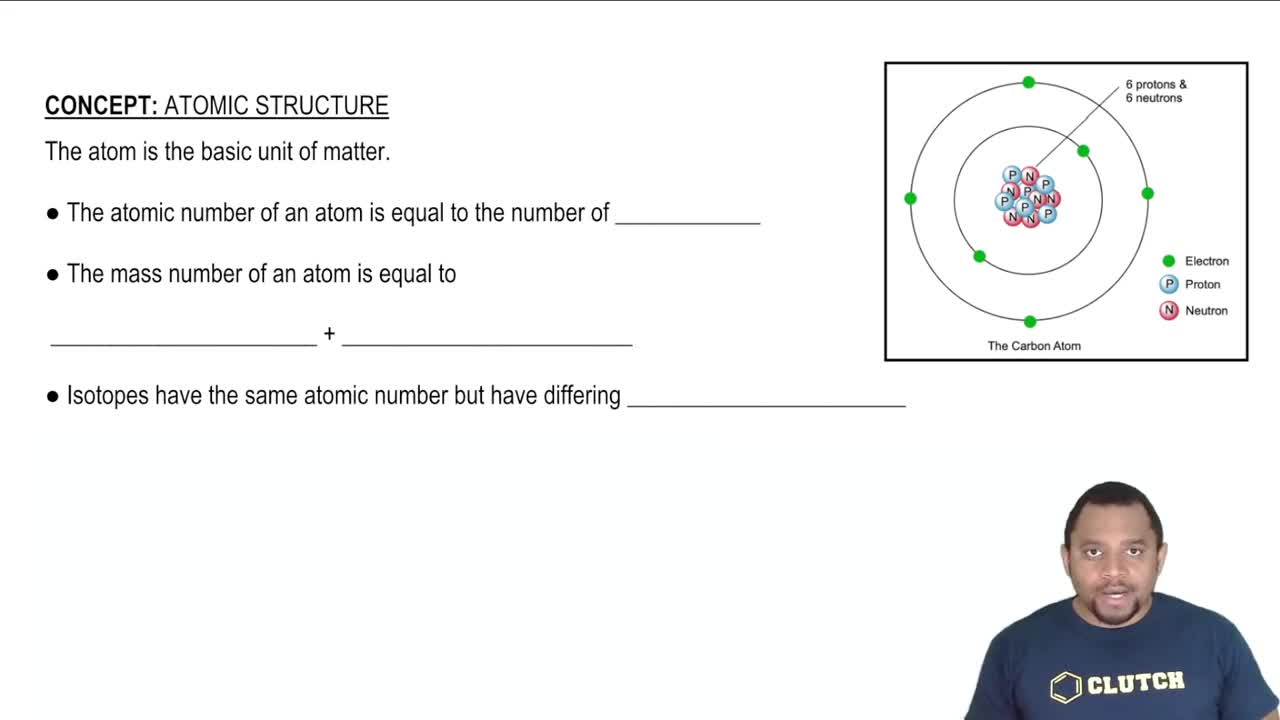
The difference between atomic numbers and atomic mass.

Chirality Without Asymmetric Carbons

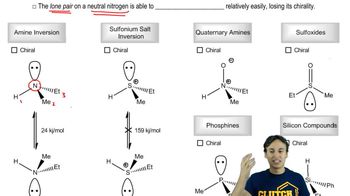
Some molecules can exhibit chirality even in the absence of asymmetric carbon atoms due to the presence of other structural features, such as restricted rotation around double bonds or the overall three-dimensional arrangement of atoms. This can lead to the formation of stereoisomers that are not mirror images but still possess distinct spatial arrangements, affecting their chemical properties.
Video consigliato:
05:41
Understanding Other Chiral Atoms

Three-Dimensional Molecular Representation

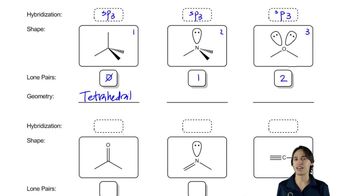
Three-dimensional representations of molecules, such as ball-and-stick models or space-filling models, help visualize the spatial arrangement of atoms and the overall geometry of the compound. These models are essential for understanding how molecular shape influences reactivity, polarity, and interactions with other molecules, particularly in the context of chirality and stereochemistry.
Video consigliato:
07:44
Molecular Geometry Explained.
Pratica correlata
Domanda del libro di testo

Draw a three-dimensional structure for each compound, and star all asymmetric carbon atoms. Draw the mirror for each structure, and state whether you have drawn a pair of enantiomers or just the same molecule twice. Build molecular models of any of these examples that seem difficult to you.

(i)

946
views
Domanda del libro di testo
Draw three-dimensional representations of the following compounds. Which have asymmetric carbon atoms? Which have no asymmetric carbons but are chiral anyway? Use your models for parts (a) through (d) and any others that seem unclear. c. ClHC═C═C(CH3)2 1-chloro-3-methylbuta-1,2-diene d. ClHC═CH―CH═CH2 1-chlorobuta-1,3-diene
1294
views
Domanda del libro di testo

For each of the stereocenters (circled) in Figure 5-5,

a. draw the compound with two of the groups on the stereocenter interchanged.

b. give the relationship of the new compound to the original compound.

1844
views
Domanda del libro di testo
In Problem 5-3 , you drew the enantiomers for a number of chiral compounds. Now go back and designate each asymmetric carbon atom as either (R) or (S). e. Chlorocyclohexane f. Cis-1,2-dichlorocyclobutane
1201
views
Domanda del libro di testo
Make a model and draw a three-dimensional structure for each compound. Then draw the mirror image of your original structure and determine whether the mirror image is the same compound. Label each structure as being chiral or achiral, and label pairs of enantiomers. a. cis-1,2-dimethylcyclobutane b. trans-1,2-dimethylcyclobutane
703
views
Domanda del libro di testo
Draw a Fischer projection for each compound. Remember that the cross represents an asymmetric carbon atom, and the carbon chain should be along the vertical, with the IUPAC numbering from top to bottom. a. (S)-propane-1,2-diol b. (R)-2-bromobutan-1-ol
2777
views
1
rank