Draw three-dimensional representations of the following compounds.
Which have asymmetric carbon atoms? Which have no asymmetric carbons but are chiral anyway?
Use your models for parts (a) through (d) and any others that seem unclear.
c. ClHC═C═C(CH3)2
1-chloro-3-methylbuta-1,2-diene
d. ClHC═CH―CH═CH2
1-chlorobuta-1,3-diene
Guida verificata passo dopo passo
1
Identify the structure of each compound by drawing their Lewis structures.
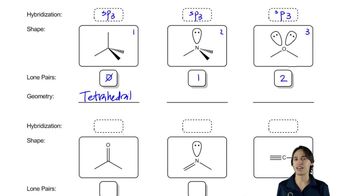
For each compound, determine the hybridization of each carbon atom to understand the geometry around them.
Check for the presence of asymmetric carbon atoms (chiral centers) by identifying carbon atoms bonded to four different groups.
For compounds without asymmetric carbons, analyze the overall molecular symmetry to determine if they are chiral due to their spatial arrangement.
Use molecular models or visualization tools to confirm the three-dimensional arrangement and chirality of each compound.
Risposta video verificata per un problema simile:
Questa soluzione video è stata consigliata dai nostri tutor come utile per risolvere questo problema.
Durata del video:
6m
Guarda un video:
0 Commenti
Concetti chiave
Ecco i concetti essenziali che devi comprendere per rispondere correttamente alla domanda.
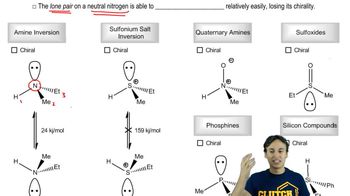
Asymmetric Carbon Atoms
Asymmetric carbon atoms, or chiral centers, are carbon atoms that are bonded to four different substituents. This unique arrangement allows for the existence of non-superimposable mirror images, known as enantiomers. Identifying these centers is crucial for determining the chirality of a compound, which can significantly influence its chemical behavior and interactions.
The difference between atomic numbers and atomic mass.
Chirality Without Asymmetric Carbons
Some molecules can exhibit chirality even in the absence of asymmetric carbon atoms due to the presence of other structural features, such as restricted rotation around double bonds or the overall three-dimensional arrangement of the molecule. This can lead to the formation of stereoisomers that are not mirror images of each other, thus making the compound chiral despite lacking traditional chiral centers.
Three-dimensional representations of molecules, such as ball-and-stick models or space-filling models, help visualize the spatial arrangement of atoms and the geometry of the compound. These models are essential for understanding the stereochemistry of a molecule, including the orientation of substituents around chiral centers and the overall shape, which can affect reactivity and interactions with other molecules.


 Guida verificata passo dopo passo
 01:44
01:44