Ch.5 - Stereochemistry
Wade - Organic Chemistry 9th Edition
Wade9th EditionOrganic ChemistryISBN: 9780135213728Non è quello che usi tu?Cambia libro di testo
Capitolo 5, Problema 7c,d

In Problem 5-3, you drew the enantiomers for a number of chiral compounds. Now go back and designate each asymmetric carbon atom as either (R) or (S).
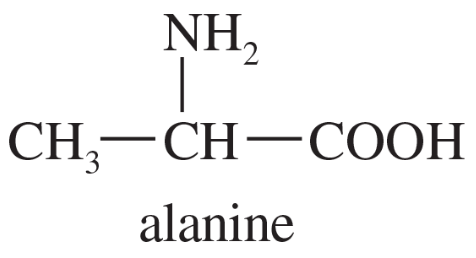
(c)
(d) 1-bromo-2-methylbutane

Guida verificata passo dopo passo
1
Step 1: Identify the chiral center in alanine (c). The chiral center is the carbon atom bonded to four different groups: NH₂, CH₃, H, and COOH.
Step 2: Assign priorities to the substituents around the chiral center in alanine based on the Cahn-Ingold-Prelog priority rules. The highest priority is given to the group with the atom of highest atomic number directly attached to the chiral center.
Step 3: Orient the molecule so that the lowest priority group (H) is pointing away from you. Then, determine the order of the remaining groups (1 → 2 → 3) and decide if the rotation is clockwise (R) or counterclockwise (S).
Step 4: For 1-bromo-2-methylbutane (d), identify the chiral center, which is the carbon atom bonded to four different groups: Br, CH₃, H, and CH₂CH₃.
Step 5: Repeat the process of assigning priorities, orienting the molecule, and determining the configuration (R or S) for 1-bromo-2-methylbutane using the Cahn-Ingold-Prelog rules.

Risposta video verificata per un problema simile:

Questa soluzione video è stata consigliata dai nostri tutor come utile per risolvere questo problema.
Durata del video:
5m

Concetti chiave

Ecco i concetti essenziali che devi comprendere per rispondere correttamente alla domanda.

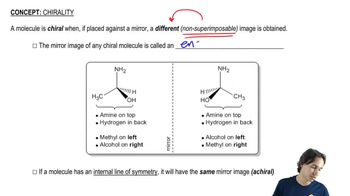
Chirality

Chirality refers to the geometric property of a molecule that makes it non-superimposable on its mirror image. Molecules that possess chirality typically have one or more asymmetric carbon atoms, which are carbon atoms bonded to four different substituents. This property is crucial in organic chemistry as it affects the behavior of molecules in biological systems, influencing how they interact with enzymes and receptors.
Video consigliato:
05:10
What is chirality?

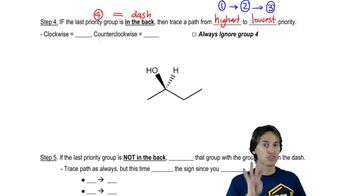
R and S Nomenclature

The R and S nomenclature system is used to assign configurations to chiral centers in molecules. The Cahn-Ingold-Prelog priority rules are applied to determine the order of substituents attached to the chiral carbon. If the priority of the substituents decreases in a clockwise direction, the configuration is designated as (R); if it decreases counterclockwise, it is designated as (S). This system is essential for accurately describing the stereochemistry of chiral compounds.
Video consigliato:
03:07
R and S Naming- Step 4

Asymmetric Carbon Atom

An asymmetric carbon atom, also known as a chiral center, is a carbon atom that is bonded to four different groups or atoms. The presence of an asymmetric carbon is what gives rise to enantiomers, which are pairs of molecules that are mirror images of each other. Identifying and designating these carbon atoms is fundamental in understanding the stereochemistry of organic compounds, particularly in the context of biological activity and drug design.
Video consigliato:
01:44
The difference between atomic numbers and atomic mass.