Ch. 7 - Structure and Synthesis of Alkenes; Elimination
Wade - Organic Chemistry 9th Edition
Wade9th EditionOrganic ChemistryISBN: 9780135213728Non è quello che usi tu?Cambia libro di testo
Capitolo 7, Problema 16

[FIGURE: KEY MECHANISM 7-1]

Show what happens in step 2 of the example if the solvent acts as a nucleophile (forming a bond to carbon) rather than as a base (removing a proton).

Guida verificata passo dopo passo
1
Step 1: Analyze the given reaction mechanism. In the original step, the solvent (ethanol or methanol) acts as a base, removing a proton from the carbocation intermediate to form a double bond. However, in this modified scenario, the solvent acts as a nucleophile, forming a bond with the carbocation instead.
Step 2: Identify the carbocation intermediate. The positively charged carbon is highly electrophilic and can be attacked by the nucleophilic oxygen atom of the solvent molecule (CH3CH2OH or CH3OH). The lone pair of electrons on the oxygen atom will initiate the attack.
Step 3: Draw the nucleophilic attack. The oxygen atom of the solvent forms a bond with the carbocation, resulting in a new intermediate where the solvent is attached to the carbon. This step involves the movement of electrons from the oxygen's lone pair to the carbocation.
Step 4: Consider the proton transfer. After the nucleophilic attack, the oxygen atom in the solvent will carry a positive charge due to the bond formation. To stabilize this intermediate, a proton transfer occurs, where a nearby base (possibly another solvent molecule) removes a proton from the positively charged oxygen.
Step 5: Finalize the product. The result of this mechanism is a new compound where the solvent is covalently bonded to the original carbon atom. The reaction does not produce a double bond as in the original mechanism but instead forms an ether-like product.

Risposta video verificata per un problema simile:

Questa soluzione video è stata consigliata dai nostri tutor come utile per risolvere questo problema.
Durata del video:
3m

Concetti chiave

Ecco i concetti essenziali che devi comprendere per rispondere correttamente alla domanda.

Nucleophilicity

Nucleophilicity refers to the ability of a species to donate an electron pair to form a new bond. In organic reactions, nucleophiles are typically negatively charged or neutral species with lone pairs of electrons. In the context of the question, the solvent (methanol, CH3OH) acts as a nucleophile, attacking the positively charged carbon center to form a new bond.
Video consigliato:
08:27
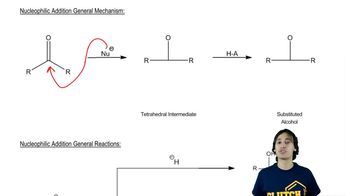
Nucleophilic Addition

Mechanism of Nucleophilic Substitution

Nucleophilic substitution is a fundamental reaction mechanism in organic chemistry where a nucleophile replaces a leaving group in a molecule. The mechanism can proceed via different pathways, such as SN1 or SN2, depending on the structure of the substrate and the conditions. Understanding this mechanism is crucial for predicting the outcome of the reaction when the solvent acts as a nucleophile.
Video consigliato:
01:47
Nucleophiles and Electrophiles can react in Substitution Reactions.

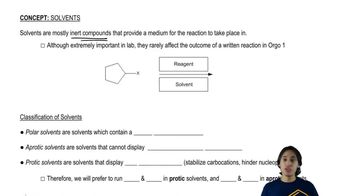
Role of Solvents in Organic Reactions

Solvents can play multiple roles in organic reactions, acting either as a medium for the reaction or participating in the reaction itself. In this case, the solvent (methanol) is not just a passive medium but actively participates as a nucleophile. This dual role can significantly influence the reaction pathway and the products formed, highlighting the importance of solvent choice in organic synthesis.
Video consigliato:
02:26
General format of reactions and how to interpret solvents.