Ch. 7 - Structure and Synthesis of Alkenes; Elimination
Wade - Organic Chemistry 9th Edition
Wade9th EditionOrganic ChemistryISBN: 9780135213728Non è quello che usi tu?Cambia libro di testo
Capitolo 7, Problema 17a

SN1 substitution and E1 elimination frequently compete in the same reaction.
a. Propose a mechanism and predict the products for the solvolysis of 2-bromo-2,3,3-trimethylbutane in methanol.

Guida verificata passo dopo passo
1
Identify the substrate: The compound 2-bromo-2,3,3-trimethylbutane is a tertiary alkyl halide. Tertiary alkyl halides are prone to undergoing SN1 and E1 mechanisms due to the stability of the carbocation intermediate formed during the reaction.
Determine the reaction conditions: The reaction occurs in methanol, which is a polar protic solvent. Polar protic solvents stabilize carbocations and favor SN1 and E1 mechanisms. Methanol can also act as a nucleophile in the SN1 pathway.
Propose the first step of the mechanism: The reaction begins with the departure of the bromide ion (Br⁻), forming a tertiary carbocation at the 2-position. This step is the rate-determining step for both SN1 and E1 mechanisms. Represent this step as: R-Br→R++Br-.
Propose the SN1 pathway: In the SN1 mechanism, methanol acts as a nucleophile and attacks the carbocation, forming an intermediate oxonium ion. This intermediate is then deprotonated by another methanol molecule to yield the substitution product, 2-methoxy-2,3,3-trimethylbutane.
Propose the E1 pathway: In the E1 mechanism, a base (methanol or another molecule) abstracts a proton from a β-hydrogen (on the 3-position), leading to the formation of a double bond. This results in the elimination product, 2,3,3-trimethyl-2-butene. Note that the E1 product is favored at higher temperatures due to the entropy increase associated with elimination.

Risposta video verificata per un problema simile:

Questa soluzione video è stata consigliata dai nostri tutor come utile per risolvere questo problema.
Durata del video:
4m

Concetti chiave

Ecco i concetti essenziali che devi comprendere per rispondere correttamente alla domanda.

SN1 Mechanism

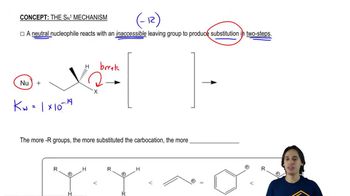
The SN1 mechanism is a type of nucleophilic substitution reaction that occurs in two steps. First, the leaving group departs, forming a carbocation intermediate. This is followed by the nucleophile attacking the carbocation. The rate of the reaction depends only on the concentration of the substrate, making it unimolecular.
Video consigliato:
10:49
Drawing the SN1 Mechanism

E1 Mechanism

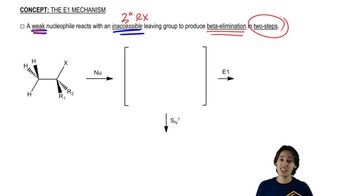
The E1 mechanism is an elimination reaction that also proceeds in two steps. Similar to SN1, the first step involves the formation of a carbocation after the leaving group departs. In the second step, a base abstracts a proton from a neighboring carbon, resulting in the formation of a double bond. The E1 reaction competes with SN1 when conditions favor elimination.
Video consigliato:
08:09
Drawing the E1 Mechanism.

Carbocation Stability

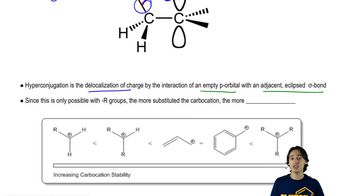
Carbocation stability is crucial in determining the pathway of reactions involving SN1 and E1 mechanisms. Tertiary carbocations, like the one formed from 2-bromo-2,3,3-trimethylbutane, are more stable due to hyperconjugation and inductive effects from surrounding alkyl groups. This stability influences the likelihood of substitution versus elimination reactions occurring.
Video consigliato:
05:58
Determining Carbocation Stability
Pratica correlata
Domanda del libro di testo

For each set of isomers, choose the isomer that you expect to be most stable and the isomer you expect to be least stable.

(c)

643
views

Domanda del libro di testo

[FIGURE: KEY MECHANISM 7-1]

Show what happens in step 2 of the example if the solvent acts as a nucleophile (forming a bond to carbon) rather than as a base (removing a proton).

1514
views
Domanda del libro di testo

The solvolysis of 2-bromo-3-methylbutane potentially can give several products, ­including both E1 and products from both the unrearranged carbocation and the rearranged ­carbocation. Mechanisms 6-6 and 7-2 show the products from the rearranged carbocation. Summarize all the possible products, showing which carbocation they come from and whether they are the products of E1 or reactions.

<IMAGES>

1778
views
1
rank
Domanda del libro di testo

SN1 substitution and E1 elimination frequently compete in the same reaction.

b. Compare the function of the solvent (methanol) in the E1 and SN1 reactions.

920
views
Domanda del libro di testo

Finish Solved Problem 7-3 by showing how the rearranged carbocations give the four products shown in the problem. Be careful when using curved arrows to show ­deprotonation and/or nucleophilic attack by the solvent. The curved arrows always show ­movement of electrons, not movement of protons or other species.

1071
views
Domanda del libro di testo

For each set of isomers, choose the isomer that you expect to be most stable and the isomer you expect to be least stable.

(b)

688
views