Ch. 7 - Structure and Synthesis of Alkenes; Elimination
Wade - Organic Chemistry 9th Edition
Wade9th EditionOrganic ChemistryISBN: 9780135213728Non è quello che usi tu?Cambia libro di testo
Capitolo 7, Problema 55f

Predict the dehydrohalogenation product(s) that result when the following alkyl halides are heated in alcoholic KOH. When more than one product is formed, predict the major and minor products.
(f) Chemical structure of an alkyl halide with hydrogen and bromine atoms, illustrating dehydrohalogenation reactions.

Guida verificata passo dopo passo
1
Step 1: Analyze the structure of the given alkyl halide. The molecule is a bicyclic compound with two bromine atoms attached to adjacent carbons in a trans configuration. This setup is ideal for an E2 elimination reaction, as the anti-periplanar geometry is satisfied.
Step 2: Recall the mechanism of dehydrohalogenation in the presence of alcoholic KOH. The reaction proceeds via an E2 elimination mechanism, where a base abstracts a proton from a β-carbon, and the leaving group (Br) departs simultaneously, forming a double bond.
Step 3: Identify the β-hydrogens available for elimination. In this case, the β-hydrogens are located on the carbons adjacent to the carbons bearing the bromine atoms. The anti-periplanar geometry ensures that elimination can occur effectively.
Step 4: Predict the possible products. The elimination of HBr from either bromine atom can lead to the formation of two different alkenes. The double bond can form between the two carbons bearing the bromine atoms or between one of these carbons and a neighboring carbon.
Step 5: Determine the major and minor products. According to Zaitsev's rule, the more substituted alkene is generally the major product. Analyze the substitution pattern of the possible alkenes to predict which one will be the major product.

Risposta video verificata per un problema simile:

Questa soluzione video è stata consigliata dai nostri tutor come utile per risolvere questo problema.
Durata del video:
7m

Concetti chiave

Ecco i concetti essenziali che devi comprendere per rispondere correttamente alla domanda.

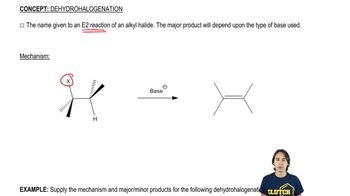
Dehydrohalogenation

Dehydrohalogenation is an elimination reaction where a hydrogen atom and a halogen atom (like bromine) are removed from adjacent carbon atoms in an alkyl halide, resulting in the formation of an alkene. This reaction typically occurs under basic conditions, such as with alcoholic KOH, which facilitates the removal of the halide and proton.
Video consigliato:
03:02
The dehydrohalogenation mechanism.

Zaitsev's Rule

Zaitsev's Rule states that in elimination reactions, the more substituted alkene is usually the major product. This is because more substituted alkenes are generally more stable due to hyperconjugation and the inductive effect, leading to a preference for their formation over less substituted alkenes.
Video consigliato:
01:18
Defining Zaitsev’s Rule

Regioselectivity

Regioselectivity refers to the preference of a chemical reaction to yield one structural isomer over others when multiple products are possible. In the context of dehydrohalogenation, regioselectivity helps predict which alkene product will be favored based on the stability of the resulting double bond and the arrangement of substituents.
Video consigliato:
05:09
Heck Reaction