Ch. 7 - Structure and Synthesis of Alkenes; Elimination
Wade - Organic Chemistry 9th Edition
Wade9th EditionOrganic ChemistryISBN: 9780135213728Non è quello che usi tu?Cambia libro di testo
Capitolo 7, Problema 56a,b,c

Using cyclohexane as your starting material, show how you would synthesize each of the following compounds. (Once you have shown how to synthesize a compound, you may use it as the starting material in any later parts of this problem.)
a. bromocyclohexane
b. cyclohexene
c. ethoxycyclohexane

Guida verificata passo dopo passo
1
Step 1: To synthesize bromocyclohexane (compound a) from cyclohexane, perform a free radical halogenation reaction. Use bromine (Br₂) in the presence of ultraviolet (UV) light or heat to initiate the reaction. This will result in the substitution of one hydrogen atom on cyclohexane with a bromine atom, forming bromocyclohexane.
Step 2: To synthesize cyclohexene (compound b) from bromocyclohexane, perform an elimination reaction. Use a strong base, such as potassium tert-butoxide (KOtBu) or sodium ethoxide (NaOEt), in an alcohol solvent. The base will abstract a β-hydrogen, leading to the formation of a double bond and producing cyclohexene.
Step 3: To synthesize ethoxycyclohexane (compound c) from cyclohexene, perform an electrophilic addition reaction. First, react cyclohexene with ethanol (C₂H₅OH) in the presence of an acid catalyst, such as sulfuric acid (H₂SO₄). This will result in the addition of an ethoxy group (-OCH₂CH₃) to the cyclohexane ring, forming ethoxycyclohexane.
Step 4: Ensure that each reaction is carried out under the appropriate conditions (e.g., temperature, solvent, and catalyst) to maximize yield and minimize side reactions. For example, control the amount of bromine in Step 1 to avoid over-halogenation.
Step 5: Verify the structures of the synthesized compounds using spectroscopic techniques such as NMR or IR spectroscopy to confirm the success of each reaction.

Risposta video verificata per un problema simile:

Questa soluzione video è stata consigliata dai nostri tutor come utile per risolvere questo problema.
Durata del video:
4m

Concetti chiave

Ecco i concetti essenziali che devi comprendere per rispondere correttamente alla domanda.

Electrophilic Substitution

Electrophilic substitution is a fundamental reaction mechanism in organic chemistry where an electrophile replaces a hydrogen atom in an aromatic or aliphatic compound. In the case of synthesizing bromocyclohexane from cyclohexane, bromine acts as the electrophile, and the reaction typically requires a catalyst, such as iron(III) bromide, to facilitate the substitution process.
Video consigliato:
01:47
Nucleophiles and Electrophiles can react in Substitution Reactions.

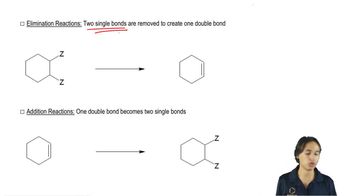
Elimination Reactions

Elimination reactions involve the removal of atoms or groups from a molecule, resulting in the formation of a double bond. To synthesize cyclohexene from cyclohexane, a common method is dehydrohalogenation, where a halogen and a hydrogen atom are removed, often using a strong base like potassium hydroxide, leading to the formation of the alkene.
Video consigliato:
00:40
Recognizing Elimination Reactions.

Nucleophilic Substitution

Nucleophilic substitution is a reaction where a nucleophile replaces a leaving group in a molecule. In the synthesis of ethoxycyclohexane, cyclohexanol can be reacted with ethyl bromide in the presence of a base, allowing the ethoxy group to substitute for the hydroxyl group, resulting in the formation of the ether.
Video consigliato:
01:47
Nucleophiles and Electrophiles can react in Substitution Reactions.