Ch. 7 - Structure and Synthesis of Alkenes; Elimination
Wade - Organic Chemistry 9th Edition
Wade9th EditionOrganic ChemistryISBN: 9780135213728Non è quello che usi tu?Cambia libro di testo
Capitolo 7, Problema 61c

Propose mechanisms for the following reactions. Additional products may be formed, but your mechanism only needs to explain the products shown.
(c) Chemical reaction diagram showing brominated compound converting to multiple products with ethyl alcohol and heat.

Guida verificata passo dopo passo
1
Step 1: Identify the reaction type. The reaction involves a brominated compound reacting with ethanol (EtOH) under heat. This suggests a nucleophilic substitution (SN1 or SN2) or elimination (E1 or E2) mechanism, depending on the conditions and the structure of the substrate.
Step 2: Analyze the substrate. The brominated compound is a secondary alkyl halide attached to a bicyclic structure. The bulky structure and the use of heat favor an E1 elimination mechanism, but the presence of ethanol as a nucleophile also allows for substitution reactions.
Step 3: Propose the E1 elimination mechanism. In the E1 pathway, the bromine leaves first, forming a carbocation intermediate. The bicyclic structure stabilizes the carbocation through hyperconjugation. A proton is then removed from a β-carbon by ethanol acting as a base, leading to the formation of the alkene product.
Step 4: Propose the SN1 substitution mechanism. In the SN1 pathway, the bromine leaves first, forming the same carbocation intermediate. Ethanol acts as a nucleophile and attacks the carbocation, leading to the formation of the ether product (with the ethoxy group, OEt).
Step 5: Consider product distribution. The reaction conditions (heat and ethanol) favor both elimination and substitution. The products include the alkene formed via E1 elimination, the ether formed via SN1 substitution, and a rearranged ether product due to possible carbocation rearrangement before nucleophilic attack.

Risposta video verificata per un problema simile:

Questa soluzione video è stata consigliata dai nostri tutor come utile per risolvere questo problema.
Durata del video:
12m

Concetti chiave

Ecco i concetti essenziali che devi comprendere per rispondere correttamente alla domanda.

Reaction Mechanisms

A reaction mechanism is a step-by-step description of how reactants transform into products during a chemical reaction. It outlines the sequence of elementary steps, including bond breaking and formation, and provides insight into the intermediates and transition states involved. Understanding mechanisms is crucial for predicting the products of reactions and for grasping the underlying principles of organic chemistry.
Video consigliato:
02:16
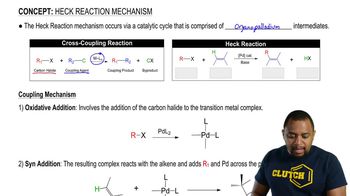
Heck Reaction Mechanism

Nucleophiles and Electrophiles

Nucleophiles are species that donate an electron pair to form a chemical bond, while electrophiles are electron-deficient species that accept an electron pair. In organic reactions, identifying the nucleophile and electrophile is essential for predicting the direction of the reaction and the formation of products. This concept is fundamental in understanding substitution and addition reactions.
Video consigliato:
03:
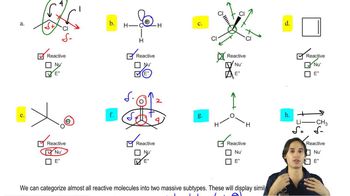
Nucleophile or Electrophile

Functional Groups

Functional groups are specific groups of atoms within molecules that are responsible for the characteristic chemical reactions of those molecules. They determine the reactivity and properties of organic compounds. Recognizing functional groups in reactants and products is vital for proposing accurate mechanisms and understanding how different reactions occur.
Video consigliato:
02:36
Identifying Functional Groups
Pratica correlata
Domanda del libro di testo

Silver-assisted solvolysis of bromomethylcyclopentane in methanol gives a complex product mixture of the following five compounds. Propose mechanisms to account for these products.

(b)

457
views

Domanda del libro di testo

Silver-assisted solvolysis of bromomethylcyclopentane in methanol gives a complex product mixture of the following five compounds. Propose mechanisms to account for these products.

(a)

857
views
Domanda del libro di testo

Propose mechanisms for the following reactions. Additional products may be formed, but your mechanism only needs to explain the products shown.

(a)

2589
views
Domanda del libro di testo

Propose mechanisms for the following reactions. Additional products may be formed, but your mechanism only needs to explain the products shown.

(b)

637
views
Domanda del libro di testo

Silver-assisted solvolysis of bromomethylcyclopentane in methanol gives a complex product mixture of the following five compounds. Propose mechanisms to account for these products.

(c)

247
views
Domanda del libro di testo

E1 eliminations of alkyl halides are rarely useful for synthetic purposes because they give mixtures of substitution and elimination products. Explain why the sulfuric acid-catalyzed dehydration of cyclohexanol gives a good yield of cyclohexene even though the reaction goes by an E1 mechanism. (Hint: What are the nucleophiles in the reaction mixture? What products are formed if these nucleophiles attack the carbocation? What further reactions can these substitution products undergo?)

1615
views