Ch. 7 - Structure and Synthesis of Alkenes; Elimination
Wade - Organic Chemistry 9th Edition
Wade9th EditionOrganic ChemistryISBN: 9780135213728Non è quello che usi tu?Cambia libro di testo
Capitolo 7, Problema 63a

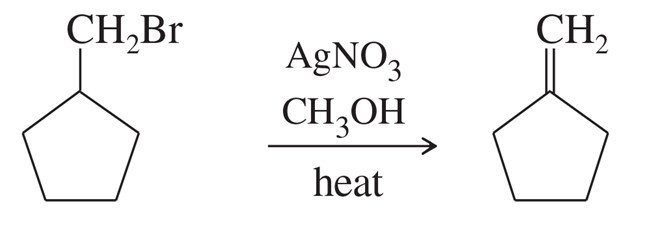
Silver-assisted solvolysis of bromomethylcyclopentane in methanol gives a complex product mixture of the following five compounds. Propose mechanisms to account for these products.
(a)

Guida verificata passo dopo passo
1
Step 1: Recognize the reaction conditions. The reaction involves bromomethylcyclopentane undergoing solvolysis in methanol with silver nitrate (AgNO₃) under heat. Silver nitrate assists in the removal of the bromide ion (Br⁻), forming a carbocation intermediate.
Step 2: Identify the carbocation intermediate. The loss of Br⁻ generates a cyclopentylmethyl carbocation, which is a primary carbocation. This carbocation can undergo rearrangements or react directly to form products.
Step 3: Propose mechanisms for product formation. (a) The carbocation can lose a proton (H⁺) from the adjacent carbon to form cyclopentene via elimination. (b) Methanol (CH₃OH) can act as a nucleophile, attacking the carbocation to form methoxycyclopentane. (c) The carbocation can rearrange to form a cyclohexyl carbocation via a ring expansion, which can then lose a proton to form cyclohexene or react with methanol to form methoxycyclohexane.
Step 4: Explain the role of heat. Heat facilitates the solvolysis reaction and promotes carbocation rearrangements and elimination reactions, leading to the observed mixture of products.
Step 5: Summarize the product formation. The five products—cyclopentene, methoxycyclopentane, cyclohexene, methoxycyclohexane, and the rearranged ketone—are formed through a combination of nucleophilic substitution, elimination, and carbocation rearrangement mechanisms.

Risposta video verificata per un problema simile:

Questa soluzione video è stata consigliata dai nostri tutor come utile per risolvere questo problema.
Durata del video:
2m

Concetti chiave

Ecco i concetti essenziali che devi comprendere per rispondere correttamente alla domanda.

Solvolysis

Solvolysis is a type of nucleophilic substitution reaction where a solvent acts as a nucleophile, attacking a substrate to form new products. In this case, methanol (CH3OH) serves as the solvent that reacts with bromomethylcyclopentane. Understanding solvolysis is crucial for predicting the reaction pathway and the resulting product mixture.
Video consigliato:
08:16
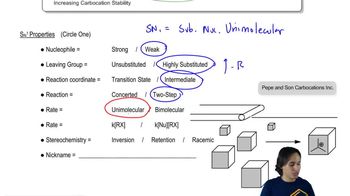
Understanding the properties of SN1.

Nucleophilic Substitution Mechanisms

Nucleophilic substitution can occur via two primary mechanisms: SN1 and SN2. The SN1 mechanism involves a two-step process where the leaving group departs first, forming a carbocation intermediate, followed by nucleophilic attack. In contrast, the SN2 mechanism is a one-step process where the nucleophile attacks the substrate simultaneously as the leaving group departs. Identifying which mechanism predominates is essential for predicting the products formed in this reaction.
Video consigliato:
01:47
Nucleophiles and Electrophiles can react in Substitution Reactions.

Silver Ion Catalysis

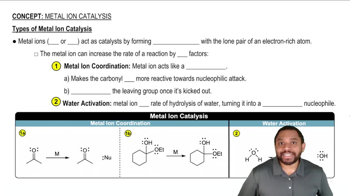
Silver ions (Ag+) can facilitate nucleophilic substitution reactions by stabilizing the leaving group, in this case, bromide (Br-), thus promoting the formation of a carbocation. This catalytic effect can influence the reaction pathway and the distribution of products. Understanding the role of silver ions in this context is important for explaining the complexity of the product mixture resulting from the reaction.
Video consigliato:
Percorso guidato
3:39
Metal Ion Catalysis Concept 1