
Ch.8 - Reactions of Alkenes
Wade - Organic Chemistry 9th Edition
Wade9th EditionOrganic ChemistryISBN: 9780135213728Non è quello che usi tu?Cambia libro di testo
Capitolo 8, Problema 23a,b

Give the expected major product for each reaction, including stereochemistry where applicable.
(a) but-1-ene + H2/Pt
(b) cis-but-2-ene + H2/Ni

Guida verificata passo dopo passo
1
Step 1: Recognize the type of reaction occurring in both cases. The addition of H2 in the presence of a metal catalyst (Pt or Ni) is a hydrogenation reaction, which converts alkenes into alkanes by adding hydrogen atoms across the double bond.
Step 2: For part (a), identify the structure of but-1-ene. It is a linear alkene with a double bond between the first and second carbon atoms. The hydrogenation reaction will break the double bond and add one hydrogen atom to each of the two carbons involved in the double bond.
Step 3: For part (b), identify the structure of cis-but-2-ene. It is a linear alkene with a double bond between the second and third carbon atoms, and the substituents on the double bond are on the same side (cis configuration). The hydrogenation reaction will break the double bond and add one hydrogen atom to each of the two carbons involved in the double bond.
Step 4: Consider stereochemistry. In hydrogenation reactions, the addition of hydrogen atoms occurs on the same face of the molecule (syn addition). However, since the product is an alkane (saturated hydrocarbon), stereochemistry is no longer relevant because alkanes do not have geometric isomers.
Step 5: Write the expected major product for each reaction. For part (a), the product will be butane (CH3-CH2-CH2-CH3). For part (b), the product will also be butane (CH3-CH2-CH2-CH3), as the cis configuration of the starting material does not affect the final alkane product.

Risposta video verificata per un problema simile:

Questa soluzione video è stata consigliata dai nostri tutor come utile per risolvere questo problema.
Durata del video:
6m

Concetti chiave

Ecco i concetti essenziali che devi comprendere per rispondere correttamente alla domanda.

Hydrogenation

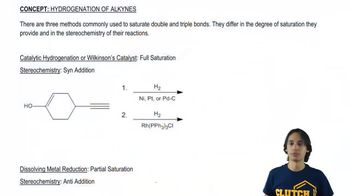
Hydrogenation is a chemical reaction that involves the addition of hydrogen (H2) to an unsaturated compound, typically alkenes or alkynes, in the presence of a catalyst such as platinum (Pt) or nickel (Ni). This process converts double or triple bonds into single bonds, resulting in saturated hydrocarbons. The stereochemistry of the product can vary depending on the substrate and conditions, but generally, hydrogenation leads to the formation of more stable, saturated products.
Video consigliato:
00:48
The definition of hydrogenation.

Stereochemistry

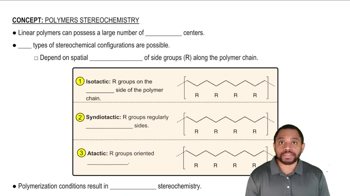
Stereochemistry refers to the study of the spatial arrangement of atoms in molecules and how this affects their chemical behavior. In reactions involving alkenes, the configuration of substituents around the double bond can lead to different stereoisomers, such as cis and trans forms. Understanding stereochemistry is crucial for predicting the major product of reactions, especially when dealing with chiral centers or when specific stereochemical outcomes are required.
Video consigliato:
Percorso guidato
1:38
Polymer Stereochemistry Concept 1

Catalytic Hydrogenation Conditions

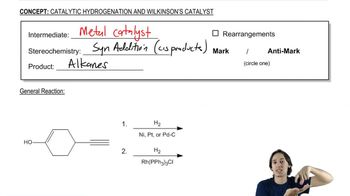
Catalytic hydrogenation conditions involve the use of a metal catalyst (like Pt or Ni) under specific temperature and pressure settings to facilitate the addition of hydrogen to alkenes. The choice of catalyst and reaction conditions can influence the rate of reaction and the selectivity of the product. For example, using different catalysts can lead to variations in the stereochemical outcome of the hydrogenation, making it essential to consider these factors when predicting the major product.
Video consigliato:
05:21
General properties of catalytic hydrogenation.
Pratica correlata
Domanda del libro di testo

Show how you would accomplish the following synthetic conversions.

a. 3-methylpent-2-ene → 2-chloro-3-methylpentan-3-ol

Problem-Solving Hint: The opening of a halonium ion is driven by its electrophilic nature. The weak nucleophile attacks the carbon bearing more positive charge.

1280
views
Domanda del libro di testo

The chiral BINAP ligand shown in Figure 8-8 contains no asymmetric carbon atoms. Explain how this ligand is chiral.

1305
views
Domanda del libro di testo

One of the principal components of lemongrass oil is limonene, C10H16. When limonene is treated with excess hydrogen and a platinum catalyst, the product is an alkane of ­formula C10H20. What can you conclude about the structure of limonene?

1291
views
Domanda del libro di testo

Show how you would accomplish the following synthetic conversions.

b. chlorocyclohexane → trans-2-chlorocyclohexanol

Problem-Solving Hint: The opening of a halonium ion is driven by its electrophilic nature. The weak nucleophile attacks the carbon bearing more positive charge.

1135
views
Domanda del libro di testo

Show how you would accomplish the following synthetic conversions.

c. 1-methylcyclopentanol → 2-chloro-1-methylcyclopentanol

Problem-Solving Hint: The opening of a halonium ion is driven by its electrophilic nature. The weak nucleophile attacks the carbon bearing more positive charge.

950
views
Domanda del libro di testo

Give the expected major product for each reaction, including stereochemistry where applicable.

(c)

(d)

2137
views