Ch.8 - Reactions of Alkenes
Wade - Organic Chemistry 9th Edition
Wade9th EditionOrganic ChemistryISBN: 9780135213728Non è quello che usi tu?Cambia libro di testo
Capitolo 8, Problema 23c,d

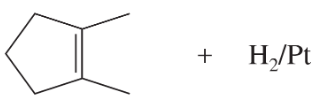
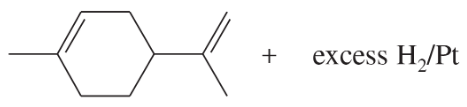
Give the expected major product for each reaction, including stereochemistry where applicable.
(c)
(d)

Guida verificata passo dopo passo
1
Step 1: Identify the type of reaction. Both reactions involve catalytic hydrogenation using H2 and Pt, which reduces double bonds (π bonds) in alkenes to single bonds (σ bonds). This process adds hydrogen atoms across the double bond.
Step 2: For reaction (c), analyze the structure of the reactant. The reactant is a cyclohexene derivative with one double bond. Hydrogenation will convert the double bond into a single bond, resulting in a saturated cyclohexane ring. The stereochemistry of the product will be relevant if the reaction occurs in a stereoselective manner.
Step 3: For reaction (d), analyze the structure of the reactant. The reactant contains two double bonds: one in the cyclohexene ring and one in the side chain. With excess H2 and Pt, both double bonds will be reduced to single bonds, resulting in a fully saturated hydrocarbon. Ensure to account for the stereochemistry of the product if applicable.
Step 4: Consider the regioselectivity and stereoselectivity of the hydrogenation process. Hydrogenation typically occurs in a syn-addition manner, meaning that both hydrogen atoms are added to the same face of the double bond. This can influence the stereochemistry of the final product.
Step 5: Draw the expected major products for both reactions. For (c), the product will be a cyclohexane derivative with no double bonds. For (d), the product will be a fully saturated hydrocarbon with no double bonds in either the ring or the side chain.

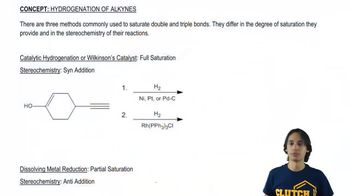
Risposta video verificata per un problema simile:

Questa soluzione video è stata consigliata dai nostri tutor come utile per risolvere questo problema.
Durata del video:
6m

Concetti chiave

Ecco i concetti essenziali che devi comprendere per rispondere correttamente alla domanda.

Hydrogenation

Hydrogenation is a chemical reaction that involves the addition of hydrogen (H2) to an unsaturated compound, typically an alkene or alkyne, in the presence of a catalyst such as platinum (Pt). This process converts double or triple bonds into single bonds, resulting in a saturated compound. Understanding hydrogenation is crucial for predicting the major product of reactions involving alkenes or cyclic compounds.
Video consigliato:
00:48
The definition of hydrogenation.

Stereochemistry

Stereochemistry refers to the study of the spatial arrangement of atoms in molecules and how this affects their chemical behavior. In reactions like hydrogenation, the stereochemistry of the product can vary based on the orientation of the reactants and the mechanism of the reaction. Recognizing stereochemical outcomes, such as cis or trans configurations, is essential for accurately predicting the major product.
Video consigliato:
Percorso guidato
1:38
Polymer Stereochemistry Concept 1

Catalysis

Catalysis is the process of increasing the rate of a chemical reaction by adding a substance known as a catalyst, which is not consumed in the reaction. In the context of hydrogenation, platinum serves as a catalyst that facilitates the addition of hydrogen to the substrate. Understanding the role of catalysts is important for predicting reaction pathways and the efficiency of the transformation.
Video consigliato:
Percorso guidato
2:31
Nucleophilic Catalysis Concept 1