

Ch.8 - Reactions of Alkenes
Wade - Organic Chemistry 9th Edition
Wade9th EditionOrganic ChemistryISBN: 9780135213728Non è quello che usi tu?Cambia libro di testo
Capitolo 8, Problema 21e

Predict the major product(s) for each reaction. Include stereochemistry where appropriate.
e. 1-methylcyclopentene + Br2 in saturated aqueous NaCl

Guida verificata passo dopo passo
1
Step 1: Recognize the type of reaction. The addition of Br2 to an alkene is a halogenation reaction, which typically proceeds via an anti-addition mechanism. The presence of saturated aqueous NaCl introduces the possibility of competing nucleophiles (Br⁻ and Cl⁻).
Step 2: Analyze the mechanism. The reaction begins with the electrophilic attack of Br2 on the double bond of 1-methylcyclopentene, forming a bromonium ion intermediate. This intermediate is a three-membered ring structure with a positive charge on the bromine atom.
Step 3: Consider the nucleophiles present. In saturated aqueous NaCl, both Br⁻ and Cl⁻ are available as nucleophiles. These nucleophiles can attack the bromonium ion from the opposite side of the ring (anti-addition), leading to the formation of trans products.
Step 4: Predict the stereochemistry. The attack by the nucleophile (Br⁻ or Cl⁻) occurs on the opposite side of the bromonium ion, resulting in anti-addition. This means the two substituents (Br and Cl or Br and Br) will be added to opposite faces of the cyclopentane ring.
Step 5: Identify the major product(s). The major products will be trans-1-bromo-2-chloro-1-methylcyclopentane and trans-1,2-dibromo-1-methylcyclopentane, depending on whether Cl⁻ or Br⁻ acts as the nucleophile. The stereochemistry should be clearly indicated in the product structures.

Risposta video verificata per un problema simile:

Questa soluzione video è stata consigliata dai nostri tutor come utile per risolvere questo problema.
Durata del video:
7m

Concetti chiave

Ecco i concetti essenziali che devi comprendere per rispondere correttamente alla domanda.

Electrophilic Addition Reactions

Electrophilic addition reactions involve the addition of electrophiles to alkenes or alkynes, where the double or triple bond acts as a nucleophile. In the case of 1-methylcyclopentene reacting with Br2, the alkene undergoes a reaction with bromine, leading to the formation of a vicinal dibromide. Understanding the mechanism of this reaction is crucial for predicting the major product.
Video consigliato:
05:39
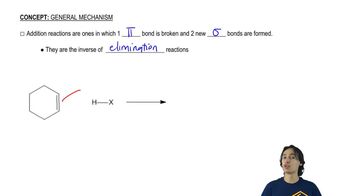
Features of Addition Mechanisms.

Stereochemistry

Stereochemistry refers to the spatial arrangement of atoms in molecules and how this affects their chemical behavior. In the reaction of 1-methylcyclopentene with Br2, the formation of a bromonium ion intermediate can lead to different stereochemical outcomes, including the possibility of forming enantiomers. Recognizing the stereochemical implications is essential for accurately predicting the products.
Video consigliato:
Percorso guidato
1:38
Polymer Stereochemistry Concept 1

Regioselectivity

Regioselectivity is the preference of a chemical reaction to yield one structural isomer over others when multiple products are possible. In the reaction of 1-methylcyclopentene with Br2 in aqueous NaCl, the regioselectivity will determine which carbon atoms of the alkene bond with bromine. This concept is important for understanding the distribution of products and the major product formed in the reaction.
Video consigliato:
05:09
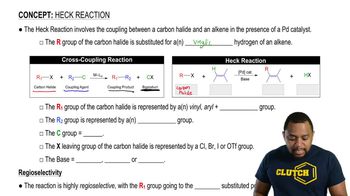
Heck Reaction
Pratica correlata
Domanda del libro di testo

Show how you would accomplish the following synthetic conversions.

a. 3-methylpent-2-ene → 2-chloro-3-methylpentan-3-ol

Problem-Solving Hint: The opening of a halonium ion is driven by its electrophilic nature. The weak nucleophile attacks the carbon bearing more positive charge.

1280
views
Domanda del libro di testo

Predict the major product(s) for each reaction. Include stereochemistry where appropriate.

c. cis-but-2-ene + Cl2/H2O

d. trans-but-2-ene + Cl2/H2O

1527
views
Domanda del libro di testo

Show how you would accomplish the following synthetic conversions.

b. chlorocyclohexane → trans-2-chlorocyclohexanol

Problem-Solving Hint: The opening of a halonium ion is driven by its electrophilic nature. The weak nucleophile attacks the carbon bearing more positive charge.

1135
views
Domanda del libro di testo

Show how you would accomplish the following synthetic conversions.

c. 1-methylcyclopentanol → 2-chloro-1-methylcyclopentanol

Problem-Solving Hint: The opening of a halonium ion is driven by its electrophilic nature. The weak nucleophile attacks the carbon bearing more positive charge.

950
views
Domanda del libro di testo

The solutions to Solved Problem 8-6 showed only how one enantiomer of the product is formed. For each product, show how an equally probable reaction forms the other enantiomer.

1244
views
Domanda del libro di testo

Predict the major product(s) for each reaction. Include stereochemistry where appropriate.

a. 1-methylcyclohexene + Cl2/H2O

b. 2-methylbut-2-ene + Br2/H2O

2009
views