
Ch.8 - Reactions of Alkenes
Wade - Organic Chemistry 9th Edition
Wade9th EditionOrganic ChemistryISBN: 9780135213728Non è quello che usi tu?Cambia libro di testo
Capitolo 8, Problema 21c,d

Predict the major product(s) for each reaction. Include stereochemistry where appropriate.
c. cis-but-2-ene + Cl2/H2O
d. trans-but-2-ene + Cl2/H2O

Guida verificata passo dopo passo
1
Step 1: Recognize the reaction type. The reaction involves an alkene (cis-but-2-ene or trans-but-2-ene) reacting with Cl₂ in the presence of H₂O. This is a halohydrin formation reaction, where the alkene undergoes electrophilic addition to form a halohydrin (a molecule containing both a halogen and a hydroxyl group).
Step 2: Analyze the mechanism. The reaction proceeds via the formation of a cyclic chloronium ion intermediate. The π-electrons of the alkene attack the Cl₂ molecule, leading to the formation of the cyclic intermediate and a chloride ion (Cl⁻).
Step 3: Determine the regioselectivity. The water molecule (H₂O) acts as a nucleophile and attacks the more substituted carbon of the cyclic chloronium ion. This occurs because the more substituted carbon is better able to stabilize the partial positive charge in the transition state.
Step 4: Consider stereochemistry. For cis-but-2-ene, the addition of Cl and OH groups will occur in an anti fashion (opposite sides of the double bond plane). Similarly, for trans-but-2-ene, the anti addition will also occur, but the stereochemistry of the product will differ due to the initial geometry of the alkene.
Step 5: Draw the products. For cis-but-2-ene, the major product will be a pair of enantiomers (R,S and S,R configurations) due to anti addition. For trans-but-2-ene, the major product will also be a pair of enantiomers (R,R and S,S configurations). Ensure to include the correct stereochemistry in the final structures.

Risposta video verificata per un problema simile:

Questa soluzione video è stata consigliata dai nostri tutor come utile per risolvere questo problema.
Durata del video:
16m

Concetti chiave

Ecco i concetti essenziali che devi comprendere per rispondere correttamente alla domanda.

Electrophilic Addition Reactions

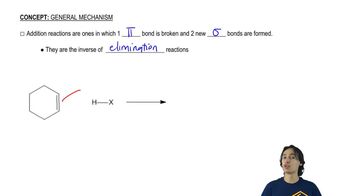
Electrophilic addition reactions involve the addition of an electrophile to a nucleophile, typically across a double bond. In the case of alkenes, the π bond is broken, allowing for the formation of new σ bonds. Understanding this mechanism is crucial for predicting the products of reactions involving alkenes, such as the addition of Cl2 and H2O to but-2-ene.
Video consigliato:
05:39
Features of Addition Mechanisms.

Stereochemistry

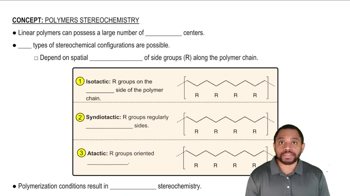
Stereochemistry refers to the spatial arrangement of atoms in molecules and how this affects their chemical behavior. In reactions involving alkenes, the formation of chiral centers can lead to different stereoisomers. Recognizing the stereochemical outcomes, especially in reactions with reagents like Cl2 and H2O, is essential for accurately predicting the major products.
Video consigliato:
Percorso guidato
1:38
Polymer Stereochemistry Concept 1

Markovnikov's Rule

Markovnikov's Rule states that in the addition of HX to an alkene, the hydrogen atom will attach to the carbon with the greater number of hydrogen atoms already attached. This principle helps predict the regioselectivity of electrophilic addition reactions, such as the addition of Cl2 and H2O to but-2-ene, guiding the formation of the major product based on the stability of the resulting carbocation.
Video consigliato:
03:54
The 18 and 16 Electron Rule