Ch.8 - Reactions of Alkenes
Wade - Organic Chemistry 9th Edition
Wade9th EditionOrganic ChemistryISBN: 9780135213728Non è quello che usi tu?Cambia libro di testo
Capitolo 8, Problema 32b,c

Predict the major products of the following reactions.
b. trans-hex-3-ene + peroxyacetic acid (CH3CO3H) in water
c. 1-methylcyclohexene + MMPP in ethanol

Guida verificata passo dopo passo
1
Step 1: Recognize the type of reaction occurring in each case. Both reactions involve the addition of an epoxide group to an alkene. Peroxyacids (CH3CO3H and MMPP) are used to convert alkenes into epoxides via electrophilic addition.
Step 2: For reaction b (trans-hex-3-ene + CH3CO3H in water), note that the trans-alkene geometry will influence the stereochemistry of the epoxide product. The reaction proceeds via a concerted mechanism, preserving the stereochemistry of the starting alkene. The trans-hex-3-ene will yield a trans-epoxide.
Step 3: For reaction c (1-methylcyclohexene + MMPP in ethanol), the cyclic structure of 1-methylcyclohexene will result in the formation of a single epoxide product. The methyl group on the cyclohexene ring does not affect the regioselectivity of the epoxidation, as the reaction occurs at the double bond.
Step 4: Consider the solvent effects. In reaction b, water may facilitate hydrolysis of the epoxide under acidic or basic conditions, potentially leading to diol formation. However, the major product is the epoxide unless hydrolysis is explicitly stated. In reaction c, ethanol does not significantly alter the epoxidation mechanism.
Step 5: Draw the major products for each reaction. For reaction b, the product is trans-hex-3-ene epoxide. For reaction c, the product is 1-methylcyclohexene epoxide. Ensure stereochemistry is correctly represented in the structures.

Risposta video verificata per un problema simile:

Questa soluzione video è stata consigliata dai nostri tutor come utile per risolvere questo problema.
Durata del video:
7m

Concetti chiave

Ecco i concetti essenziali che devi comprendere per rispondere correttamente alla domanda.

Electrophilic Addition Reactions

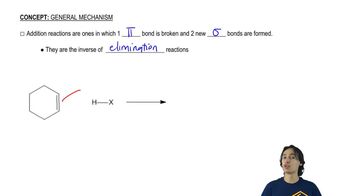
Electrophilic addition reactions involve the addition of an electrophile to a nucleophile, typically across a double bond. In the case of alkenes, the π bond is broken, allowing for the formation of new σ bonds. Understanding this mechanism is crucial for predicting the products of reactions involving alkenes, such as the reaction of trans-hex-3-ene with peroxyacetic acid.
Video consigliato:
05:39
Features of Addition Mechanisms.

Peroxyacetic Acid as an Oxidizing Agent

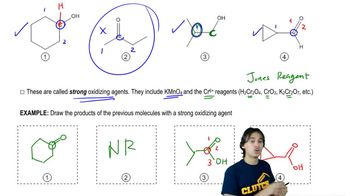
Peroxyacetic acid (CH3CO3H) is a peracid that can act as an oxidizing agent in organic reactions. It is commonly used to convert alkenes into epoxides or to perform oxidation reactions. Recognizing its role in the reaction with trans-hex-3-ene helps in predicting the formation of epoxide products and subsequent hydrolysis in water.
Video consigliato:
05:53
Strong oxidizing agents

MMPP and its Role in Organic Synthesis

MMPP (m-chloroperbenzoic acid) is a reagent used for the oxidation of alkenes to form epoxides or for other transformations. In the reaction with 1-methylcyclohexene, MMPP facilitates the formation of an epoxide intermediate, which can lead to various products depending on the reaction conditions. Understanding MMPP's reactivity is essential for predicting the outcomes of the reaction in ethanol.
Video consigliato:
Percorso guidato
1:16
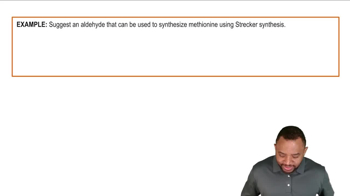
Synthesis of Amino Acids: Strecker Synthesis Example 1
Pratica correlata
Domanda del libro di testo

Predict the major products of the following reactions, including stereochemistry.

a. cyclohexene + KMnO4/H2O (cold, dilute)

b. cyclohexene + peroxyacetic acid in water

1646
views

Domanda del libro di testo

Magnesium monoperoxyphthalate (MMPP) epoxidizes alkenes much like mCPBA. MMPP is more stable, however, and it may be safer to use for large-scale and industrial reactions. Propose a mechanism for the reaction of trans-2-methylhept-3-ene with MMPP, and predict the structure of the product(s).

1604
views
Domanda del libro di testo

When 1,2-epoxycyclohexane (cyclohexene oxide) is treated with anhydrous HCl in methanol, the principal product is trans-2-methoxycyclohexanol. Propose a mechanism to account for the formation of this product.

1926
views
1
rank
Domanda del libro di testo

Predict the major products of the following reactions.

d. trans-cyclodecene + peroxyacetic acid in acidic water

e. cis-cyclodecene + mCPBA in CH2Cl2, then dilute aqueous acid

1826
views
Domanda del libro di testo

a. Propose a mechanism for the conversion of cis-hex-3-ene to the epoxide (3,4-­epoxyhexane) and the ring-opening reaction to give the glycol, hexane-3,4-diol. In your mechanism, pay particular attention to the stereochemistry of the intermediates and products.

b. Repeat part (a) for trans-hex-3-ene. Compare the products obtained from cis- and trans-hex-3-ene. Is this reaction sequence stereospecific?

1355
views
Domanda del libro di testo

Predict the major products of the following reactions.

a. cis-hex-2-ene + mCPBA in chloroform

1780
views