Ch.8 - Reactions of Alkenes
Wade - Organic Chemistry 9th Edition
Wade9th EditionOrganic ChemistryISBN: 9780135213728Non è quello che usi tu?Cambia libro di testo
Capitolo 8, Problema 32d,e

Predict the major products of the following reactions.
d. trans-cyclodecene + peroxyacetic acid in acidic water
e. cis-cyclodecene + mCPBA in CH2Cl2, then dilute aqueous acid

Guida verificata passo dopo passo
1
Step 1: Recognize that both reactions involve the epoxidation of alkenes followed by acid-catalyzed ring opening of the epoxide. The reagents used (peroxyacetic acid and mCPBA) are common peroxy acids for epoxidation.
Step 2: For reaction (d), trans-cyclodecene reacts with peroxyacetic acid (CH₃COOOH) to form a trans-epoxide. The stereochemistry of the alkene dictates the stereochemistry of the epoxide, maintaining the trans configuration.
Step 3: In the second step of reaction (d), the acidic water (H₃O⁺) opens the epoxide ring via protonation of the oxygen atom, followed by nucleophilic attack by water. This results in a diol with anti stereochemistry due to the trans configuration of the starting material.
Step 4: For reaction (e), cis-cyclodecene reacts with mCPBA in CH₂Cl₂ to form a cis-epoxide. The stereochemistry of the alkene dictates the stereochemistry of the epoxide, maintaining the cis configuration.
Step 5: In the second step of reaction (e), the acidic water (H₃O⁺) opens the epoxide ring via protonation of the oxygen atom, followed by nucleophilic attack by water. This results in a diol with syn stereochemistry due to the cis configuration of the starting material.

Risposta video verificata per un problema simile:

Questa soluzione video è stata consigliata dai nostri tutor come utile per risolvere questo problema.
Durata del video:
10m

Concetti chiave

Ecco i concetti essenziali che devi comprendere per rispondere correttamente alla domanda.

Electrophilic Addition Reactions

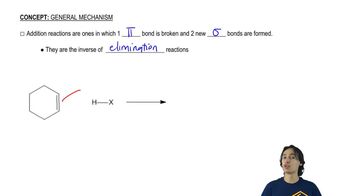
Electrophilic addition reactions involve the addition of electrophiles to nucleophilic sites in alkenes or alkynes. In the context of the reactions provided, the double bonds in trans-cyclodecene and cis-cyclodecene act as nucleophiles, reacting with electrophiles such as peroxyacetic acid and mCPBA, leading to the formation of new bonds and products.
Video consigliato:
05:39
Features of Addition Mechanisms.

Peracid Reactions

Peracids, like peroxyacetic acid and mCPBA, are strong oxidizing agents that can facilitate the formation of epoxides from alkenes. In the reactions described, these peracids react with the double bonds to form epoxide intermediates, which can then undergo further reactions in acidic conditions to yield diols or other products.
Video consigliato:
05:09
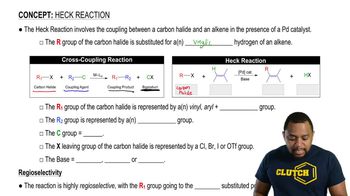
Heck Reaction

Acid-Catalyzed Hydrolysis

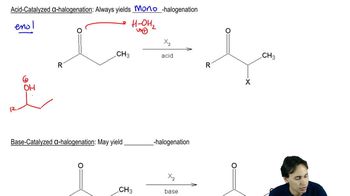
Acid-catalyzed hydrolysis is a reaction where water, in the presence of an acid, reacts with an epoxide or other reactive intermediate to form alcohols. In the given reactions, after the formation of epoxides, the addition of dilute aqueous acid (H3O+) leads to the opening of the epoxide ring, resulting in the formation of diols as the final products.
Video consigliato:
03:09
Acid Catalyzed