

Ch.8 - Reactions of Alkenes
Wade - Organic Chemistry 9th Edition
Wade9th EditionOrganic ChemistryISBN: 9780135213728Non è quello che usi tu?Cambia libro di testo
Capitolo 8, Problema 50c

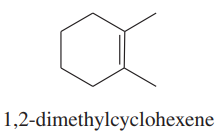
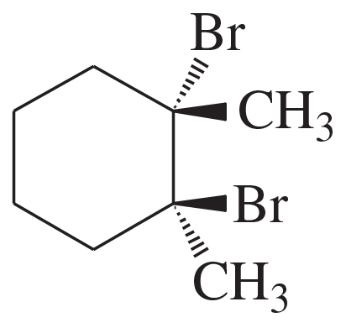
Using 1,2-dimethylcyclohexene as your starting material, show how you would synthesize the following compounds. (Once you have shown how to synthesize a compound, you may use it as the starting material in any later parts of this problem.) If a chiral product is shown, assume that it is part of a racemic mixture.
Chemical structure of 1,2-dimethylcyclohexene, a starting material for synthesis in organic chemistry.
(c)

Guida verificata passo dopo passo
1
Step 1: Analyze the starting material, 1,2-dimethylcyclohexene. It is an alkene with a double bond between two carbons in the cyclohexane ring, and two methyl groups attached to the carbons involved in the double bond.
Step 2: Recognize the target product, which is a vicinal dibromide (two bromine atoms attached to adjacent carbons). This suggests the use of an anti-addition reaction mechanism.
Step 3: To achieve the transformation, use bromine (Br₂) in an inert solvent like CCl₄. Bromine reacts with the double bond in an anti-addition manner, forming a bromonium ion intermediate.
Step 4: The bromonium ion intermediate is attacked by a bromide ion (Br⁻) from the opposite side, leading to the anti-addition of bromine across the double bond. This results in the formation of the vicinal dibromide product.
Step 5: Since the product is chiral, the reaction produces a racemic mixture (equal amounts of both enantiomers) due to the planar nature of the double bond in the starting material.

Risposta video verificata per un problema simile:

Questa soluzione video è stata consigliata dai nostri tutor come utile per risolvere questo problema.
Durata del video:
5m

Concetti chiave

Ecco i concetti essenziali che devi comprendere per rispondere correttamente alla domanda.

Electrophilic Addition Reactions

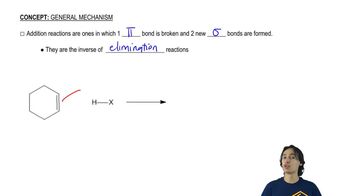
Electrophilic addition reactions are fundamental in organic chemistry, particularly for alkenes like 1,2-dimethylcyclohexene. In these reactions, an electrophile reacts with the double bond of the alkene, leading to the formation of a more saturated product. Understanding the mechanism of these reactions, including the formation of carbocations and the role of nucleophiles, is crucial for synthesizing various compounds from alkenes.
Video consigliato:
05:39
Features of Addition Mechanisms.

Stereochemistry

Stereochemistry involves the study of the spatial arrangement of atoms in molecules and how this affects their chemical behavior. In the context of synthesizing compounds from 1,2-dimethylcyclohexene, recognizing chiral centers and understanding concepts like enantiomers and diastereomers is essential. This knowledge is particularly important when dealing with racemic mixtures, as it influences the properties and reactivity of the synthesized products.
Video consigliato:
Percorso guidato
1:38
Polymer Stereochemistry Concept 1

Functional Group Transformations

Functional group transformations are reactions that convert one functional group into another, which is a key aspect of organic synthesis. Starting from 1,2-dimethylcyclohexene, various transformations can be employed, such as oxidation, reduction, or substitution reactions, to create desired products. Mastery of these transformations allows chemists to design synthetic pathways effectively and achieve specific molecular architectures.
Video consigliato:
02:36
Identifying Functional Groups
Pratica correlata
Domanda del libro di testo

Using 1,2-dimethylcyclohexene as your starting material, show how you would synthesize the following compounds. (Once you have shown how to synthesize a compound, you may use it as the starting material in any later parts of this problem.) If a chiral product is shown, assume that it is part of a racemic mixture.

(d)

1318
views
Domanda del libro di testo

Show how you would make the following compounds from a suitable cyclic alkene.

(f)

1197
views
Domanda del libro di testo

Show how you would make the following compounds from a suitable cyclic alkene.

(e)

1293
views
Domanda del libro di testo

Using 1,2-dimethylcyclohexene as your starting material, show how you would synthesize the following compounds. (Once you have shown how to synthesize a compound, you may use it as the starting material in any later parts of this problem.) If a chiral product is shown, assume that it is part of a racemic mixture.

(g)

1003
views
Domanda del libro di testo

Using 1,2-dimethylcyclohexene as your starting material, show how you would synthesize the following compounds. (Once you have shown how to synthesize a compound, you may use it as the starting material in any later parts of this problem.) If a chiral product is shown, assume that it is part of a racemic mixture.

(e)

842
views
Domanda del libro di testo

Using 1,2-dimethylcyclohexene as your starting material, show how you would synthesize the following compounds. (Once you have shown how to synthesize a compound, you may use it as the starting material in any later parts of this problem.) If a chiral product is shown, assume that it is part of a racemic mixture.

(a)

2177
views