

Ch.8 - Reactions of Alkenes
Wade - Organic Chemistry 9th Edition
Wade9th EditionOrganic ChemistryISBN: 9780135213728Non è quello che usi tu?Cambia libro di testo
Capitolo 8, Problema 50a

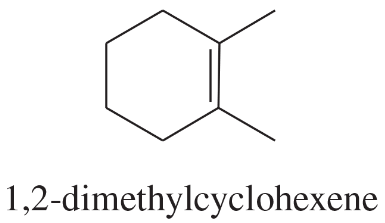
Using 1,2-dimethylcyclohexene as your starting material, show how you would synthesize the following compounds. (Once you have shown how to synthesize a compound, you may use it as the starting material in any later parts of this problem.) If a chiral product is shown, assume that it is part of a racemic mixture.

(a)

Guida verificata passo dopo passo
1
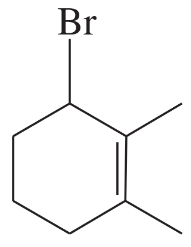
Step 1: Begin with the starting material, 1,2-dimethylcyclohexene. The goal is to add a bromine atom to the allylic position (the carbon adjacent to the double bond). This can be achieved using N-bromosuccinimide (NBS) in the presence of light or a radical initiator.
Step 2: The reaction mechanism involves the formation of a bromine radical. NBS generates bromine radicals under light or heat, which abstract a hydrogen atom from the allylic position of 1,2-dimethylcyclohexene, forming an allylic radical.
Step 3: The allylic radical is stabilized by resonance, allowing the bromine radical to add to the allylic position. This results in the formation of the desired product, 3-bromo-1,2-dimethylcyclohexene.
Step 4: Ensure that the reaction conditions are controlled to favor allylic bromination rather than addition of bromine across the double bond. Using NBS in a non-polar solvent like CCl4 helps achieve this selectivity.
Step 5: The final product, 3-bromo-1,2-dimethylcyclohexene, is obtained as part of a racemic mixture if the allylic position is chiral. This is due to the radical mechanism, which does not favor one enantiomer over the other.

Risposta video verificata per un problema simile:

Questa soluzione video è stata consigliata dai nostri tutor come utile per risolvere questo problema.
Durata del video:
6m

Concetti chiave

Ecco i concetti essenziali che devi comprendere per rispondere correttamente alla domanda.

Electrophilic Addition Reactions

Electrophilic addition reactions are fundamental in organic chemistry, particularly for alkenes like 1,2-dimethylcyclohexene. In these reactions, an electrophile reacts with the double bond of the alkene, leading to the formation of a more stable carbocation intermediate. This process is crucial for synthesizing various compounds, as it allows for the introduction of new functional groups into the molecule.
Video consigliato:
05:39
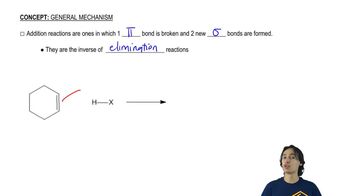
Features of Addition Mechanisms.

Stereochemistry

Stereochemistry refers to the study of the spatial arrangement of atoms in molecules and how this affects their chemical behavior. In the context of synthesizing compounds from 1,2-dimethylcyclohexene, understanding stereochemistry is essential, especially when dealing with chiral products. The formation of stereoisomers can significantly influence the properties and reactivity of the synthesized compounds.
Video consigliato:
Percorso guidato
1:38
Polymer Stereochemistry Concept 1

Rearrangement Reactions

Rearrangement reactions involve the structural reorganization of a molecule, often leading to more stable isomers. In the synthesis process, intermediates formed during electrophilic addition may undergo rearrangements to yield different products. Recognizing potential rearrangements is vital for predicting the outcome of synthetic pathways and for understanding the stability of the resulting compounds.
Video consigliato:
06:28
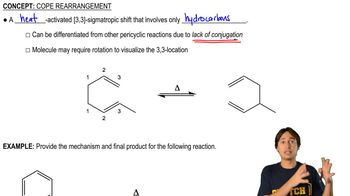
Definition of Cope Rearrangement