Ch.9 - Alkynes
Wade - Organic Chemistry 9th Edition
Wade9th EditionOrganic ChemistryISBN: 9780135213728Non è quello che usi tu?Cambia libro di testo
Capitolo 9, Problema 16a,b

Predict the major product(s) of the following reactions:
a. phenylacetylene + 2 HBr
b. hex-1-yne + 2 HCl

Guida verificata passo dopo passo
1
Step 1: Recognize the type of reaction. Both reactions involve the addition of hydrogen halides (HBr and HCl) to alkynes. This is an electrophilic addition reaction where the π-bond of the alkyne reacts with the hydrogen halide.
Step 2: Understand the regioselectivity. In the presence of excess hydrogen halide, the reaction follows Markovnikov's rule. This means the hydrogen atom from the hydrogen halide will add to the carbon of the triple bond that already has more hydrogens, while the halide (Br⁻ or Cl⁻) will add to the carbon with fewer hydrogens.
Step 3: For part (a), phenylacetylene + 2HBr: The first equivalent of HBr adds to the triple bond, forming a vinyl bromide intermediate. The second equivalent of HBr adds to the double bond of the intermediate, resulting in a geminal dibromide (both bromine atoms attached to the same carbon).
Step 4: For part (b), hex-1-yne + 2HCl: The first equivalent of HCl adds to the triple bond, forming a vinyl chloride intermediate. The second equivalent of HCl adds to the double bond of the intermediate, resulting in a geminal dichloride (both chlorine atoms attached to the same carbon).
Step 5: Verify the products. In both cases, the major product is a geminal dihalide due to the Markovnikov addition of the hydrogen halides. Ensure the structures of the products are consistent with the regioselectivity and the reaction mechanism.

Risposta video verificata per un problema simile:

Questa soluzione video è stata consigliata dai nostri tutor come utile per risolvere questo problema.
Durata del video:
7m

Concetti chiave

Ecco i concetti essenziali che devi comprendere per rispondere correttamente alla domanda.

Alkyne Reactivity

Alkynes are hydrocarbons containing a carbon-carbon triple bond, which makes them highly reactive. They can undergo addition reactions where reagents add across the triple bond. In the presence of hydrogen halides like HBr or HCl, alkynes can react to form haloalkenes or haloalkanes, depending on the number of equivalents of the halide used.
Video consigliato:
09:11
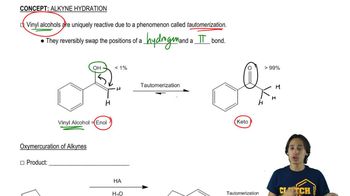
Alkyne Hydration

Markovnikov's Rule

Markovnikov's Rule states that in the addition of HX to an alkene or alkyne, the hydrogen atom will attach to the carbon with the greater number of hydrogen atoms already attached. This rule helps predict the major product of reactions involving unsymmetrical reagents, guiding the formation of more stable carbocation intermediates during the reaction.
Video consigliato:
03:54
The 18 and 16 Electron Rule

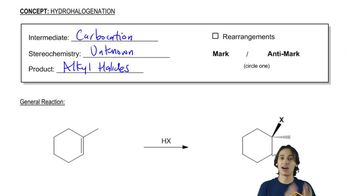
Hydrohalogenation

Hydrohalogenation is a chemical reaction where hydrogen halides (like HBr or HCl) add to alkenes or alkynes. In the case of terminal alkynes, this reaction can occur in a two-step process, where the first addition forms a vinyl halide, and a second addition can lead to a geminal dihalide. Understanding this process is crucial for predicting the products of the given reactions.
Video consigliato:
04:07
General properties of hydrohalogenation.