Ch.9 - Alkynes
Wade - Organic Chemistry 9th Edition
Wade9th EditionOrganic ChemistryISBN: 9780135213728Non è quello che usi tu?Cambia libro di testo
Capitolo 9, Problema 18a,b,c

Show how hex-1-yne might be converted to
a. 1,2-dichlorohex-1-ene.
b. 1-bromohex-1-ene.
c. 2-bromohex-1-ene.

Guida verificata passo dopo passo
1
Step 1: For part (a), to convert hex-1-yne to 1,2-dichlorohex-1-ene, perform an electrophilic addition reaction using Cl₂ in the presence of a solvent like CCl₄. The alkyne undergoes partial addition of chlorine, resulting in the formation of a dichlorinated alkene. The chlorine atoms will add across the triple bond, forming 1,2-dichlorohex-1-ene.
Step 2: For part (b), to convert hex-1-yne to 1-bromohex-1-ene, use HBr as the reagent. This reaction follows Markovnikov's rule, where the bromine atom adds to the more substituted carbon of the triple bond, resulting in 1-bromohex-1-ene. The reaction stops at the alkene stage due to controlled conditions.
Step 3: For part (c), to convert hex-1-yne to 2-bromohex-1-ene, use HBr in the presence of a peroxide (e.g., ROOR). This reaction follows anti-Markovnikov's rule due to the radical mechanism induced by the peroxide. The bromine atom adds to the less substituted carbon of the triple bond, forming 2-bromohex-1-ene.
Step 4: Ensure that the reaction conditions are carefully controlled to prevent further addition of halogens or hydrogen halides to the alkene product. For example, use stoichiometric amounts of reagents and monitor the reaction progress.
Step 5: After each reaction, purify the product using techniques such as distillation or chromatography to isolate the desired compound and confirm its structure using spectroscopic methods like NMR or IR.

Risposta video verificata per un problema simile:

Questa soluzione video è stata consigliata dai nostri tutor come utile per risolvere questo problema.
Durata del video:
8m

Concetti chiave

Ecco i concetti essenziali che devi comprendere per rispondere correttamente alla domanda.

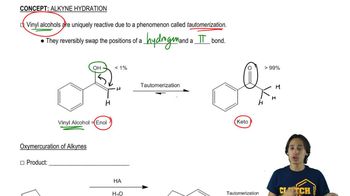
Alkyne Reactivity

Alkynes, such as hex-1-yne, are characterized by a carbon-carbon triple bond, which makes them highly reactive. This reactivity allows them to undergo various addition reactions, where reagents can add across the triple bond. Understanding the mechanisms of these reactions is crucial for converting alkynes into alkenes or other functional groups.
Video consigliato:
09:11
Alkyne Hydration

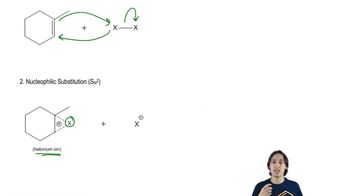
Halogenation of Alkenes

Halogenation involves the addition of halogens (like Cl or Br) to alkenes, resulting in the formation of dihalides or haloalkenes. The reaction typically proceeds via an electrophilic addition mechanism, where the double bond acts as a nucleophile. Recognizing how to control the regioselectivity of these reactions is essential for synthesizing specific products like 1,2-dichlorohex-1-ene.
Video consigliato:
03:45
Halogenation Mechanism

Regioselectivity in Organic Reactions

Regioselectivity refers to the preference of a chemical reaction to yield one structural isomer over others when multiple possibilities exist. In the context of converting hex-1-yne to various bromoalkenes, understanding how to direct the addition of bromine to specific carbon atoms is vital. This concept is particularly important when distinguishing between products like 1-bromohex-1-ene and 2-bromohex-1-ene.
Video consigliato:
02:17
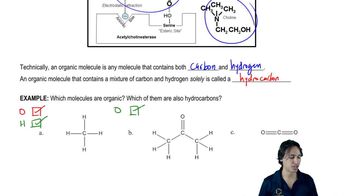
Identifying organic molecules