
Ch.9 - Alkynes
Wade - Organic Chemistry 9th Edition
Wade9th EditionOrganic ChemistryISBN: 9780135213728Non è quello che usi tu?Cambia libro di testo
Capitolo 9, Problema 18f

Show how hex-1-yne might be converted to
f. 2,2-dibromohexane.

Guida verificata passo dopo passo
1
Step 1: Begin with hex-1-yne, which is an alkyne with a triple bond between the first and second carbons in a six-carbon chain. The goal is to convert this alkyne into 2,2-dibromohexane, which is an alkane with two bromine atoms attached to the second carbon.
Step 2: Perform a hydrohalogenation reaction using excess HBr (hydrogen bromide). In the presence of excess HBr, the alkyne undergoes two successive additions of HBr. The first addition converts the triple bond into a double bond, forming a bromoalkene. The second addition converts the double bond into a single bond, forming a dibromoalkane.
Step 3: Apply Markovnikov's rule during the hydrohalogenation reaction. According to Markovnikov's rule, the hydrogen atom from HBr will add to the carbon with more hydrogen atoms (the terminal carbon in this case), while the bromine atom will add to the carbon with fewer hydrogen atoms (the second carbon). This ensures that both bromine atoms end up on the second carbon.
Step 4: Verify the structure of the product. After the reaction, the resulting compound should be 2,2-dibromohexane, where the second carbon in the chain is bonded to two bromine atoms, and the rest of the chain remains saturated with single bonds.
Step 5: Ensure reaction conditions are appropriate. The reaction typically requires a polar solvent like acetic acid or dichloromethane to facilitate the addition of HBr. Excess HBr ensures complete conversion of the alkyne to the dibromoalkane.

Risposta video verificata per un problema simile:

Questa soluzione video è stata consigliata dai nostri tutor come utile per risolvere questo problema.
Durata del video:
1m

Concetti chiave

Ecco i concetti essenziali che devi comprendere per rispondere correttamente alla domanda.

Alkyne Reactivity

Alkynes, such as hex-1-yne, are characterized by a carbon-carbon triple bond, which makes them highly reactive. This reactivity allows them to undergo various addition reactions, where reagents can add across the triple bond. Understanding how alkynes react is crucial for converting them into other compounds, such as alkenes or alkanes, which can then be further modified.
Video consigliato:
09:11
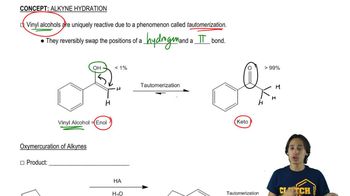
Alkyne Hydration

Halogenation

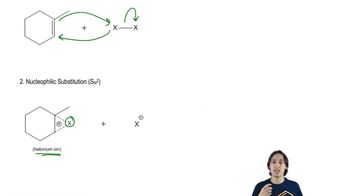
Halogenation is a chemical reaction where halogens (like bromine) are added to a compound. In the case of converting hex-1-yne to 2,2-dibromohexane, the addition of bromine across the triple bond will first yield a dibromoalkene. This step is essential for introducing the bromine atoms at the desired positions in the final product.
Video consigliato:
03:45
Halogenation Mechanism

Markovnikov's Rule

Markovnikov's Rule states that in the addition of HX (where X is a halogen) to an alkene, the hydrogen atom will attach to the carbon with the greater number of hydrogen atoms already attached. This principle helps predict the regioselectivity of the halogenation reaction, ensuring that the bromine atoms are added to the more substituted carbon, leading to the formation of 2,2-dibromohexane.
Video consigliato:
03:54
The 18 and 16 Electron Rule