
Ch.9 - Alkynes
Wade - Organic Chemistry 9th Edition
Wade9th EditionOrganic ChemistryISBN: 9780135213728Non è quello che usi tu?Cambia libro di testo
Capitolo 9, Problema 8c,d

Show how you would synthesize each compound, beginning with acetylene and any necessary additional reagents
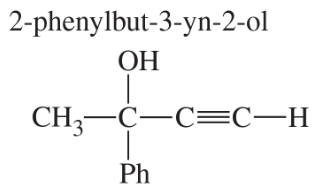
(c)
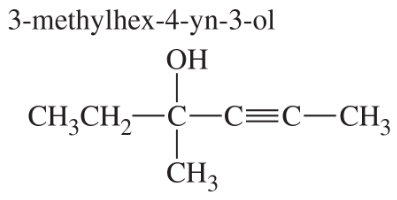
(d)

Guida verificata passo dopo passo
1
Step 1: Begin with acetylene (C≡CH) as the starting material. Deprotonate acetylene using a strong base such as sodium amide (NaNH₂) to generate the acetylide anion (C≡C⁻). This anion is highly nucleophilic and can be used for alkylation reactions.
Step 2: For compound c (2-phenylbut-3-yn-2-ol), perform an alkylation reaction by reacting the acetylide anion with benzyl bromide (PhCH₂Br) to introduce the phenyl group. This forms phenylacetylene (PhC≡CH).
Step 3: React phenylacetylene with acetone (CH₃COCH₃) in the presence of a strong base such as sodium amide (NaNH₂) or potassium tert-butoxide (KOtBu). The acetylide anion attacks the carbonyl carbon of acetone, forming the alcohol group at the 2-position and extending the chain to create 2-phenylbut-3-yn-2-ol.
Step 4: For compound d (3-methylhex-4-yn-3-ol), perform a similar alkylation reaction. React the acetylide anion with ethyl bromide (CH₃CH₂Br) to introduce the ethyl group, forming ethylacetylene (CH₃CH₂C≡CH).
Step 5: React ethylacetylene with acetone (CH₃COCH₃) in the presence of a strong base such as sodium amide (NaNH₂) or potassium tert-butoxide (KOtBu). The acetylide anion attacks the carbonyl carbon of acetone, forming the alcohol group at the 3-position and extending the chain to create 3-methylhex-4-yn-3-ol.

Risposta video verificata per un problema simile:

Questa soluzione video è stata consigliata dai nostri tutor come utile per risolvere questo problema.
Durata del video:
3m

Concetti chiave

Ecco i concetti essenziali che devi comprendere per rispondere correttamente alla domanda.

Alkyne Reactivity

Alkynes are hydrocarbons containing at least one carbon-carbon triple bond. They are more reactive than alkenes and alkanes due to the high electron density of the triple bond, which can participate in various reactions such as addition, substitution, and polymerization. Understanding the reactivity of alkynes is crucial for synthesizing compounds like 2-phenylbut-3-yn-2-ol and 3-methylhex-4-yn-3-ol.
Video consigliato:
09:11
Alkyne Hydration

Hydroboration-Oxidation

Hydroboration-oxidation is a two-step reaction used to convert alkynes into alcohols. In the first step, the alkyne reacts with diborane (B2H6) to form an organoborane intermediate. The second step involves oxidation with hydrogen peroxide (H2O2) and sodium hydroxide (NaOH), resulting in the formation of an alcohol. This method is particularly useful for synthesizing terminal and internal alcohols from alkynes.
Video consigliato:
06:38
General properties of hydroboration-oxidation.

Grignard Reagents

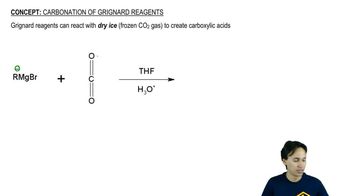
Grignard reagents are organomagnesium compounds that are highly reactive and can be used to form carbon-carbon bonds. They are created by reacting magnesium with an alkyl or aryl halide. In the synthesis of compounds like 2-phenylbut-3-yn-2-ol, Grignard reagents can be employed to introduce functional groups or to extend carbon chains, making them essential for constructing complex organic molecules.
Video consigliato:
02:12
Carbonation of Grignard Reagents