

Ch.9 - Alkynes
Wade - Organic Chemistry 9th Edition
Wade9th EditionOrganic ChemistryISBN: 9780135213728Non è quello che usi tu?Cambia libro di testo
Capitolo 9, Problema 8a

Show how you would synthesize each compound, beginning with acetylene and any necessary additional reagents
(a)

Guida verificata passo dopo passo
1
Step 1: Begin with acetylene (H—C≡C—H) as the starting material. Acetylene is a terminal alkyne, which can undergo nucleophilic substitution reactions when treated with a strong base.
Step 2: Deprotonate acetylene using a strong base such as sodium amide (NaNH₂) to generate the acetylide ion (⁻C≡C—H). This ion is highly nucleophilic and can attack electrophiles.
Step 3: React the acetylide ion with formaldehyde (H₂C=O), which is an electrophilic carbonyl compound. This reaction proceeds via nucleophilic addition, where the acetylide ion attacks the carbonyl carbon of formaldehyde.
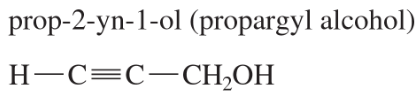
Step 4: After the nucleophilic addition, the intermediate formed is protonated using a mild acid (e.g., H₃O⁺) to yield the final product, prop-2-yn-1-ol (H—C≡C—CH₂OH).
Step 5: Verify the structure of the product to ensure it matches the desired compound, prop-2-yn-1-ol, which contains a terminal alkyne group and a hydroxymethyl (-CH₂OH) group.

Risposta video verificata per un problema simile:

Questa soluzione video è stata consigliata dai nostri tutor come utile per risolvere questo problema.
Durata del video:
6m

Concetti chiave

Ecco i concetti essenziali che devi comprendere per rispondere correttamente alla domanda.

Acetylene as a Building Block

Acetylene (C2H2) is a simple alkyne that serves as a versatile building block in organic synthesis. Its triple bond allows for various reactions, including nucleophilic additions and coupling reactions. Understanding how to manipulate acetylene is crucial for constructing more complex molecules, such as propargyl alcohol.
Video consigliato:
16:59
Building a molecular sentence

Nucleophilic Addition Reactions

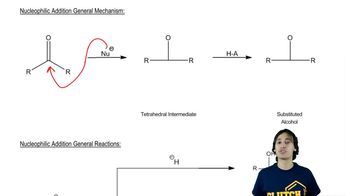
Nucleophilic addition reactions involve the attack of a nucleophile on an electrophilic carbon, often found in carbonyl compounds or alkynes. In the synthesis of propargyl alcohol, a nucleophile can add to the terminal carbon of acetylene, leading to the formation of alcohols. Mastery of these reactions is essential for building functionalized organic compounds.
Video consigliato:
08:27
Nucleophilic Addition

Functional Group Transformations

Functional group transformations are chemical reactions that convert one functional group into another, allowing for the modification of molecular structures. In synthesizing propargyl alcohol, the transformation of an alkyne to an alcohol involves specific reagents, such as water and a catalyst, to facilitate the addition of hydroxyl groups. Understanding these transformations is key to designing effective synthetic pathways.
Video consigliato:
02:36
Identifying Functional Groups