Ch.9 - Alkynes
Wade - Organic Chemistry 9th Edition
Wade9th EditionOrganic ChemistryISBN: 9780135213728Non è quello che usi tu?Cambia libro di testo
Capitolo 9, Problema 26g,h,i

Write structural formulas for the following compounds (includes both old- and new-style names).
g. 5,5-dibromo-4-phenylcyclooct-1-yne
h. (E)-6-ethyloct-2-en-4-yne
i.1,4-heptadiyne

Guida verificata passo dopo passo
1
To write the structural formula for 5,5-dibromo-4-phenylcyclooct-1-yne, start by identifying the main structure: cyclooctyne. This is a cyclooctane ring with a triple bond at the 1-position. Draw an eight-membered ring and place a triple bond between the first and second carbon atoms.
Next, add the substituents to the cyclooctyne structure. At the 4-position, attach a phenyl group, which is a benzene ring. At the 5-position, add two bromine atoms (dibromo). Ensure the bromine atoms are on the same carbon.
For (E)-6-ethyloct-2-en-4-yne, start with the octane backbone, which is a straight chain of eight carbon atoms. Identify the positions of the double and triple bonds: a double bond at the 2-position and a triple bond at the 4-position. The (E) configuration indicates that the highest priority groups on either side of the double bond are on opposite sides.
Add the ethyl group at the 6-position. An ethyl group is a two-carbon chain, CH₃CH₂. Ensure the double bond has the correct (E) configuration by placing the ethyl group and the hydrogen on opposite sides of the double bond.
For 1,4-heptadiyne, start with a seven-carbon chain (heptane). Place triple bonds at the 1-position and the 4-position. This means the first and second carbons are connected by a triple bond, and the fourth and fifth carbons are connected by another triple bond. Ensure the rest of the carbon atoms are connected by single bonds.

Risposta video verificata per un problema simile:

Questa soluzione video è stata consigliata dai nostri tutor come utile per risolvere questo problema.
Durata del video:
8m

Concetti chiave

Ecco i concetti essenziali che devi comprendere per rispondere correttamente alla domanda.

IUPAC Nomenclature

IUPAC nomenclature is a systematic method of naming organic chemical compounds as recommended by the International Union of Pure and Applied Chemistry. It provides a standardized way to name compounds based on their structure, ensuring clear communication among chemists. Understanding IUPAC rules is essential for interpreting and constructing structural formulas from names.
Video consigliato:
03:43
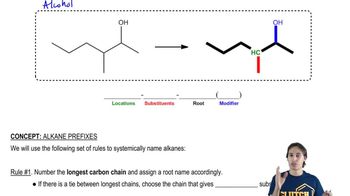
The different parts of an IUPAC name

Functional Groups

Functional groups are specific groups of atoms within molecules that are responsible for the characteristic chemical reactions of those molecules. Recognizing functional groups such as alkynes, alkenes, and phenyl groups is crucial for drawing structural formulas, as they dictate the connectivity and reactivity of the compound.
Video consigliato:
02:36
Identifying Functional Groups

Stereochemistry

Stereochemistry involves the study of the spatial arrangement of atoms in molecules and its impact on chemical behavior. Terms like (E)- and (Z)- refer to the configuration of double bonds, indicating the relative positions of substituents. Understanding stereochemistry is vital for accurately representing compounds with geometric isomers, such as alkenes.
Video consigliato:
Percorso guidato
1:38
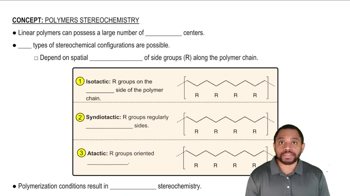
Polymer Stereochemistry Concept 1